 Enrolling Now
LB0191 - ITEC VTCT Dermaplaning (RQF EQF Level 4) 610/1553/2
Class Schedule
LB0191 現有班次 Level 1
Available
2026年10月29日 至 2026年10月29日
09:00 - 18:00
九龍深水埗
Course fee HK$ 9,000
Deposit HK$ 2,000
Course Summary
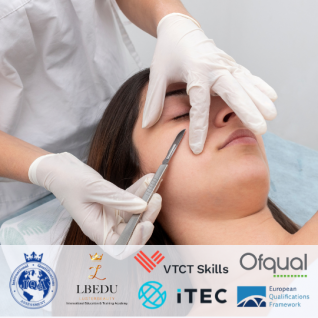
This VTCT Skills (ITEC) Level 4 Award in Dermaplaning (Ref: 610/1553/2) is designed for practitioners holding a Level 3 Beauty Therapy diploma. It teaches professional skin scalping techniques using sterile surgical blades to remove vellus hair and dead skin cells, improving skin texture, fine lines, and pigmentation. The course covers environmental safety, infection control, client consultation, skin assessment, contraindications, and practical skills including 45-degree blade angle, pressure control, systematic treatment, and aftercare. Total qualification time is 26 hours. Assessment includes an external MCQ exam, 4 case studies, and an external practical exam – exam fees are included in tuition. Graduates receive the VTCT Skills ITEC Level 4 Award, aligned with UK RQF and EU EQF frameworks. The academy is a government-registered school and Labour Department recognized job referral agency, offering free review and work placement. Ideal for beauty professionals seeking to advance in medical aesthetics and dermaplaning treatments.
Course Description


Note: No additional fees are required during the course. Graduates are welcome to return and revise course content for free.
Note: Our school is a government-registered institution and a Labour Department approved employment referral agency. Outstanding graduates may receive job referrals and teaching opportunities (e.g., Senior Beauty Therapist, Dermaplaning Specialist, Aesthetic Consultant), providing diverse career pathways.
VTCT Skills (ITEC) Level 4 Award in Dermaplaning 610/1553/2
Course Objective
- This qualification aims to develop learners' knowledge, understanding and practical skills when using dermaplaning techniques to enhance appearance.
- Learners will learn how to conduct a thorough consultation to establish client suitability for treatment and formulate a specific treatment plan tailored to individual client needs.
- Upon completion of this unit, learners will be able to:
- LO1: Interpret the environmental and safety considerations to be considered when providing dermaplaning treatments
- LO2: Comprehend the protocols and guidelines when providing dermaplaning treatments
- LO3: Demonstrate how to consult, plan and prepare for dermaplaning treatment
- LO4: Demonstrate how to provide dermaplaning treatment
Learning Hours
- Total Qualification Time (TQT): 26 hours
- Guided Learning (GL) hours: 16 hours
Entry Requirement
- Learners are required to hold a Level 3 qualification in beauty therapy (including anatomy and physiology) or an equivalent qualification.
- Learners must be aged 18 or over.
- Centres must ensure learners possess the required knowledge, understanding and skills to enrol and successfully achieve this qualification.
Course Syllabus
Unit UBT445: Enhance Appearance using Dermaplaning Techniques
- LO1: Interpret the environmental and safety considerations to be considered when providing dermaplaning treatments
- Promoting environmental and sustainable working practices
- Insurance guidelines (skin testing, informed consent, photography, post-care)
- Safety of product and equipment sourcing (regulatory compliance, reliable suppliers, MSDS)
- Suppliers' and manufacturers' instructions for safe use
- Working in line with organisational procedures (clinical governance, CPD)
- Hygiene considerations (sterile field, PPE, sharps handling, waste disposal)
- Contra-indications that would prevent or restrict treatment (e.g., allergy to surgical steel, anticoagulants, active acne, skin cancer)
- Contra-indications requiring medical referral (active acne, raised moles/lesions, suspected skin cancer)
- When to consult with other aesthetic professionals
- Treatment of minors (18+ only)
- Hazards and risks (risk assessment, avoiding sharps injuries, infection)
- LO2: Comprehend the protocols and guidelines when providing dermaplaning treatments
- Factors to consider and treatment planning (client expectations, skin analysis, Fitzpatrick scale, Glogau photo damage)
- Assessing skin characteristics (Wood's lamp, skin thickness, healing capacity, hair growth)
- Pre and post treatment advice to provide to the client (skin preparation programme, avoid retinoids/AHA, SPF30+)
- Timing of treatments (basic 30 mins, luxury 60 mins)
- Pain threshold and sensitivity variations (skin tests, tactile sensation)
- Types and purpose of dermaplaning products (cleansers, enzyme peels, antiseptics, serums, SPF)
- Preparation and selection of equipment and products for treatment
- Cleansing the skin prior to treatment
- Method of application (45° angle, correct pressure, direction, speed)
- Adaptations to treatment (avoid moles, lips, eye area)
- Uses, limitations, benefits and effects of dermaplaning products and equipment
- Contra-actions associated with the treatment (cuts, grazing, erythema, pigmentation, cold sores)
- SPF and UVA specific sun protector (UVB SPF30+ and UVA protection)
- Preventing infection and promote healing
- Treatment progression and additional/complementary treatments recommendations
- LO3: Demonstrate how to consult, plan and prepare for dermaplaning treatment
- Establish the condition of the skin (using magnifying lamp, skin diagnostic equipment, document findings)
- Explain the treatment procedures to the client
- Select a preparatory skin care programme (2-4 week home skin preparation)
- Take pre-treatment photographs
- Carry out skin sensitivity tests
- Select suitable equipment and products
- Explain the cooling off period
- LO4: Demonstrate how to provide dermaplaning treatment
- Maintain own responsibilities for health and safety through the treatment
- Prepare, position and protect the client and self
- Ensure environmental conditions are suitable for treatment
- Ensure the use of clean equipment and materials
- Safely use equipment, materials and products
- Prepare the skin (thorough cleansing, antisepsis)
- Select blade size
- Apply the dermaplaning treatment (systematic approach, client comfort, avoid overworking, wipe blade)
- Monitor the skin reaction and client response
- Apply complementary single use formulations (peptides, enzymes, vitamins, etc.)
- Apply post-treatment products (moisturisers, anti-inflammatories, antioxidants, SPF)
- Take post-treatment photographs
- Provide post care advice and home care
- Dispose of waste materials to meet legal requirements (sharps box, biohazard waste)
- Update client records
Assessment Requirements
- External Theory Examination: Multiple Choice Questions (MCQ) assessing LO1 and LO2, contributing 50% to the overall grade. Graded Fail/Pass/Merit/Distinction.
- Case Studies: Minimum of 4 different clients, complete treatment records (consultation, skin assessment, before/after photos, treatment details, evaluation). Assessed internally as Pass/Refer. Must be completed before the practical examination.
- Practical Examination: External examiner (on-site or remote) assessing LO3 and LO4, contributing 50% to the overall grade. Graded Fail/Pass/Merit/Distinction.
- All three components must be passed to achieve the qualification.
Assessment Methods
- Theory Examination (MCQ): Externally set and marked, taken online.
- Case Study Portfolio: Internally assessed (tutor marked), externally moderated by sampling.
- Practical Examination: Conducted on a real client within a commercially acceptable time frame, assessed by an external examiner.
Assessment Fee
- Included in tuition fees (waived).
Student Benefits
- Gain professional dermaplaning knowledge and practical skills
- Enhance employability in beauty salons, medical aesthetic centres, spas, and similar establishments
- Obtain an internationally recognised VTCT Skills (ITEC) Level 4 certificate
- Learn industry-standard client consultation and treatment planning processes
- Free revision of course content
- Job referral opportunities for outstanding graduates
Qualification Awarded
- VTCT Skills (ITEC) Level 4 Award in Dermaplaning
Accreditation
- VTCT (iTEC) qualification recognition
- Meets UK Regulated Qualifications Framework (RQF) and European Qualifications Framework (EQF) Level 4
Progression / Other Relevant Programmes
- VTCT Skills (ITEC) Level 4 Certificate in Skin Peeling
- VTCT Skills (ITEC) Level 4 Certificate in Skin Needling
- VTCT Skills (ITEC) Level 4 Certificate in Ultrasound
- VTCT Skills (ITEC) Level 4 Award in Scalp Micropigmentation Treatments
- VTCT Skills (ITEC) Level 5 Award in Micropigmentation for Camouflage and Restoration
Key Points
‧ Course: VTCT Skills (ITEC) Level 4 Award in Dermaplaning – Ref: 610/1553/2
‧ Qualification Level: UK RQF Level 4 / EU EQF Level 4
‧ Learning Hours: TQT 26 hrs (GLH 16 hrs)
‧ Entry: Level 3 Beauty Therapy diploma (including Anatomy & Physiology), age 18+
‧ Syllabus: 4 Learning Outcomes (environmental safety, treatment protocols, consultation & preparation, practical skills)
‧ Application: 45-degree blade angle, correct pressure, direction, speed, avoiding moles, lips, eye area
‧ Pre & post-care: 2-4 weeks skin preparation, avoid retinoids/AHA, SPF30+ sunscreen
‧ Assessment: External MCQ + 4 case studies + external practical exam
‧ Exam fee included in tuition (waived)
‧ Qualification: VTCT Skills (ITEC) Level 4 Award in Dermaplaning
‧ Government registered school – free review & job referral
Terms & Conditions
Terms and Conditions for General Courses:
- To enroll in a course/class, students are required to pay a deposit which will be deducted from the total course fee. Upon the confirmation of this enrolment, the applicant is liable to pay the balance of the total fee for the course.
- In the event of a student failing to attend the confirmed course, or complete the course for any following reasons: personal problems, illness, change of mind, relocation, pregnancy, illness or death in the family, change in personal circumstances, failure to obtain a visa or a loan, no refunds of fees or deposits will be made, no entitlement to a later-date course will be granted and the student will be liable for the outstanding course fee.
- Fees can be paid in full, at the time of enrolment. Fee can also be paid with deposit and balance which must be paid no later than seven days prior to the course start date. Failure to do so will forfeit your place on the course.
- All deposits are non-refundable and non-transferable under any circumstances.
- Under discretional circumstances, the course fees can be paid by Installment Options, subject to the school’s approval.
- Students who are approved to pay off the course fee by Installment Options, are in agreement with the school to make all payments by direct debit on preset dates. Late or non-payment may result in your removal from the Installment Option and you will be liable for the remainder of your Course fees in 10 working days.
- The direct debit must be set up a minimum of 10 working days before the course starting date. Otherwise, we reserve the right to cancel the agreed Installment Option and the full course fee is due before the course starting date instead.
- If you do not pay your Course fees in accordance with the agreed payment terms, we reserve the right to withdraw any offer, cancel your accepted place on your Course, exclude you from any relevant assessment, exam, or reassessment, leave your assessment or reassessment unmarked, or withhold assessment or reassessment results and materials for your Course.
- All students must purchase a kit(s) and towel bundles for practicing purposes unless otherwise specified (excluding Laser course(s)). Students are required to bring their own kit(s) and towel bundles on the day of training, failure to do so will result in students not being able to attend lessons/practice/be assessed.
- All students will be required to practice on other students unless models are required for the practical assessment which will then be the responsibility of the student to bring along but will be specified by LUSTER BEAUTY INTERNATIONAL EDUCATION AND TRAINING ACADEMY.
- Some courses may require a patch test at least 48 hours prior to the course date. Eye and laser treatments especially, but will be specified on the course information for health & safety.
- Any medical conditions or learning difficulties must be specified by the student prior to the course enrolment in written form (i.e. E-mail [email protected]), i.e. contra-indication to having a treatment performed, in this incidence the student will be required to bring her own model to practice on.
- As part of The Code of Practice, all students must be well presented at all times. (i.e. Hair should be neatly tied back and out of the face, no jewelry, all piercings removed for health & safety purposes, fingernails should be cut short and clean, and personal hygiene should be adhered to)
- All students will be required to wear the correct beauty tunic, black trousers, and smart closed flat black shoes. for every lesson. This includes the LUSTER BEAUTY INTERNATIONAL EDUCATION AND TRAINING ACADEMY uniform. Students are required to behave in a professional and respectful manner towards peers and staff, failure to do so will result in being removed from the course and any outstanding fees to be paid.
- If LUSTER BEAUTY INTERNATIONAL EDUCATION AND TRAINING ACADEMY has to cancel a course date which will be beyond our control, then we will try to give at least 24 hours' notice and rearrange another course date. We cannot be responsible for any loss of travel or accommodation in the event of a cancellation.
- LUSTER BEAUTY INTERNATIONAL EDUCATION AND TRAINING ACADEMY reserves the right to alter course dates or/and venue but will endeavor to give at least 24 or 48 hours' notice.
- These conditions form the main part of the contract between the School and the Student. Only the school's managing director shall be authorized to alter or waive any of the terms and conditions.
- Learners should come to our academy to pick up the certificate within six months of the notified collection date. We will not retain the overdue certificate on their behalf.
- "Terms for Semi-Permanent Makeup, Tattoo and Micro-pigmentation Related Courses" - In response to concerns raised in the beauty industry regarding the supply and use of anesthetic ointments, we examined relevant overseas practices and the current regulatory framework under (Chapter 138). In jurisdictions with a regulatory framework similar to Hong Kong, health regulators and related organizations will issue guidelines to micro-pigmentation / tattoo service providers reminding them not to supply local anesthetics to customers; local anesthetics should be obtained from registered medical practitioners or registered Pharmacies available.
In Hong Kong, CHP informs the public and the beauty industry of the risks and precautions associated with cosmetic procedures such as micro-pigmentation and tattoos, as well as organizing various events. We do not provide any anesthetic ointments, The model or guest obtains the anesthetic ointment from a registered doctor or a registered pharmacy and applies the soothing skin to the model or guest. (If any)
Terms and Conditions for VTCT (iTEC) Course:
- Enrolments are accepted subject to the following Terms of Enrolment and the Regulations of LUSTER BEAUTY INTERNATIONAL EDUCATION AND TRAINING ACADEMY, (hereafter referred to as “LBEDU”), a copy of which has been provided to the Applicants.
- The Applicant has applied to attend one of the Courses listed above, details of which have been fully explained during the interview.
- The Fee for the Course includes the cost to the School of its overhead expenses and preparatory work and all special equipment and materials required for the Course, together with payments made by the School to the organizations involved.
- A deposit is required to be paid to reserve a place on any Course. Once a deposit has been paid arrangements are made by the School to include the Applicant in the Course applied for, no repayment of the deposit can be made under any circumstances.
- Upon completion of the Enrolment Form, the Applicant is liable to pay the balance of the total fee for the Course.
- In the event of a student failing to attend the confirmed course, or complete the course for any following reasons: personal problems, illness, change of mind, relocation, pregnancy, illness or death in the family, change in personal circumstances, failure to obtain a visa or a loan, no refunds of fees or deposits will be made, no entitlement to a later-date course will be granted and the student will be liable for the outstanding course fee.
- All students who wish to pay off the course fee by Installment Options, are in agreement with the school to make all payments by either direct debit on preset dates. Late or non-payment may result in your removal from the Installment Option and you will be liable for the remainder of your Course fees in 10 working days.
- The direct debit must be set up a minimum of 10 working days before the course starting date. Otherwise, we reserve the right to cancel the agreed Installment Option and the full course fee is due before the course starting date instead.
- If you do not pay your Course fees in accordance with the agreed payment terms, we reserve the right to withdraw any offer, cancel your accepted place on your Course, exclude you from any relevant assessment, exam, or reassessment, leave your assessment or reassessment unmarked, or withhold assessment or reassessment results and materials for your Course.
- If you do not pay your Course fees in accordance with the agreed payment terms, we reserve the right to withdraw any offer, cancel your accepted place on your Course, exclude you from any relevant assessment, exam, or reassessment, leave your assessment or reassessment unmarked, or withhold assessment or reassessment results and materials for your Course.
- LBEDU reserves the right to terminate the training of any student who fails to comply with any of the School Regulations, or whose conduct is declared by the
- Principal of LBEDU to be detrimental to the running of the school. No fees are refundable in the event of the termination of the contract in these circumstances. The decision of the managing director of LBEDU is final and not subject to arbitration.
- For the purpose of ensuring that all courses are up to date LBEDU reserves the right to alter curricula and syllabi without prior notice and the sole discretion of LUSTER BEAUTY INTERNATIONAL EDUCATION AND TRAINING ACADEMY.
- The Parents or legal guardians of Applicants under 18 years of age are responsible for enrolment fees, general behavior, and discipline of that person. They are expected to give their full support and encouragement to the aims of the school and to uphold and promote its good name; to continue the students’ education at home and to punctuality, behavior, diligence, and dress. The signature of a parent or legal guardian agreeing to the Terms of Enrolment is required on the Enrolment Form.
School Regulations for Students:
- Uniform is required: a beauty tunic, black trousers, and smart closed flat black shoes.
- Hair should be put up above the collar in the chignon and kept off the face with a navy or white hair band; nails kept short and unvarnished; day make-up must be worn. Students are not allowed to wear any jewelry (to include body jewelry), other than a wedding band and ear studs (max ½ cm), during school hours.
- If locker room and wardrobes are provided for changing and personal belongings, they must be kept clean and tidy at all times. Students are asked to keep briefcases and holdalls out of the classroom areas. Mobile phones must be kept in the locker and switched off whilst on the school premises.
- Students are advised that jewelry, valuables, or considerable amounts of money must not be brought into the school as Luster Beauty International Education and Training Academy ( hereinafter referred to as “LBEDU”) cannot be held responsible for their loss.
- Students are expected to model for practical classes. Any student who cannot do so, by reason of medical deficit or infirmity, must notify LBEDU upon enrollment. LBEDU reserves the right to terminate the student’s training, on the failure to so advise.
- Students are required to attend all demonstrations and extracurricular activities.
- Client Days are an integral and mandatory part of the training offered – this to include (inter alia) Client Liaison, Sales, and Housekeeping.
- Students are asked to be in attendance and ready for class. Students who arrive late in their class will be marked absent in the register for that session. Students who are consistently late will not be permitted to attend the session. Three late will result in disciplinary action.
- Absent students are asked to telephone/email the school by 10.00 am. Messages from fellow students will not be accepted. An absence form must subsequently be completed. A medical note is required for more than three days’ absence.
- Students are considered absent for the morning or afternoon session if they leave the school without prior permission.
- Students are advised that punctuality, attendance record, neatness of work, personal presentation, conduct, and thorough knowledge of subjects are taken into account when awarding LBEDU diplomas/certificates.
- All students must complete the required number of hours in accordance with the School's and examining boards’ regulations and have thorough theoretical and practical knowledge of their course material, to be eligible for the VTCT (iTEC) examinations and assessments.
- LBEDU requires all students to pass the VTCT (iTEC) examinations with a minimum 60% before proceeding to the VTCT (iTEC) examination.
Hours, Attendance & Achievement:
- For all courses, you must have a minimum of 70% attendance for teaching in the classroom for each subject/module. For examination-based courses, you must have at least 70% attendance (if needed in course). And 70% salon hours (if needed in course). In addition, if you miss more than 100 hours in total on either an VTCT (iTEC) course, you will not be registered for the examination.
- As all courses are of a continuous nature, no allowance for lateness or absenteeism will be made except with prior consent by the Principle and General Manager, who also reserve the right to dismiss any student giving justifiable cause for such action. Their decisions in all such matters will be deemed as final.
- It is not the responsibility of the School or individual teachers to provide additional teaching hours for students to ‘catch up on education missed due to lateness or absenteeism for whatever reason.
- If a student fails a written VTCT (iTEC) theory test, the first resit is HK$800.00 and there will be an HKD800.00 per resit fee thereafter. This is subject to the student potentially having a valid reason as to why they have failed the exam and the school reserves the right to deem if the conditions as to why the student failed the test are valid. In the event of a failure of a test, it is up to the school to decide when a test can be accommodated.
- Students failing to complete their assessments, variations, ranges, etc. during the term of their course will be charged by the hour for any further teaching/supervision/assessment. These sessions will be at the convenience of the School. The current hourly rate is HKD250.00/hour.
- For assessment-based courses, it may be necessary for you to join in during the next intake to complete work and assessments missed subject to an additional fee and course availability.
- For exam retakes there will be a retake fee, for any refresher training required there will be a fee. Check with the Administration department for the current rates.
- Classes will commence promptly at the published times, irrespective of whether all students are present. Classes will not be delayed to wait for latecomers, and teachers are not responsible for repeating work missed. Latecomers may be requested to wait until a suitable break in teaching before entering a class. Class hours can be varied at the discretion of the Principle and General Manager without prior notice.
- The School will be closed on all HONG KONG public holidays. If a public holiday falls during your course, no extra days will be added to your course or reduction in fees given, we have accounted for these days within our teaching.
- Time off for official religious holidays booked holidays and planned weddings, medical appointments, etc. must be discussed and agreed upon before application. We recommend that all absences be avoided where possible.
After your submission, the registered students express their understanding and agreement to abide by the above terms and conditions.
Frequently Asked Questions
What are the entry requirements for the VTCT (ITEC) Level 4 Dermaplaning course?
Applicants must hold a Level 3 qualification in Beauty Therapy or equivalent (including Anatomy and Physiology) and be aged 18 or above.
Are assessment and certification fees included in the tuition fee?
Are assessment and certification fees included in the tuition fee?
Yes. All official VTCT assessment and certification fees are fully included in the tuition with zero hidden charges.
Can I revisit training classes after graduation?
Yes. Graduates are welcome to revisit all course modules and technology updates free of charge.
What are the assessment requirements to obtain this Level 4 qualification?
What are the assessment requirements to obtain this Level 4 qualification?
Candidates must pass three assessment components: an external theory multiple-choice exam (MCQ), a case study portfolio of at least 4 clients, and an external live or remote practical examination.
What are the key benefits of Dermaplaning treatments?
Dermaplaning safely exfoliates the dead skin cells and removes fine vellus hair, immediately enhancing skin smoothness, brightness, and skincare product absorption.
What career progression opportunities are available for outstanding graduates?
What career progression opportunities are available for outstanding graduates?
As a government-registered institute and Labour Department-recognized job referral agency, top-performing graduates receive job referrals and teaching opportunities (e.g., Senior Beauty Therapist, Dermaplaning Specialist, Aesthetic Consultant).
What international recognition does this certificate carry?
Graduates are awarded the "VTCT Skills (ITEC) Level 4 Award in Dermaplaning", which is officially recognized by VTCT (iTEC) and aligns with Level 4 of the UK Regulated Qualifications Framework (RQF) and European Qualifications Framework (EQF).
Related Courses