- Academic CPD
- three-stage CPD strategy
- educators' professional development
- lifelong learning
- teaching competence improvement
CPD Guide in Education & Academia: How Continuing Professional Development Empowers Educators' Growth
In an era of deepening educational reform and rapid iteration of academic research, "Continuing Professional Development (CPD)" has become a core pathway for education practitioners (teachers, academic researchers, education administrators, etc.) to maintain professional vitality, adapt to educational needs, and enhance academic and teaching capabilities. Whether you are a newcomer to the education sector or a seasoned educator or researcher with years of experience, systematically planning CPD can help you achieve phased breakthroughs in your educational and academic journey—this is also the core connotation of "lifelong learning" emphasized in the education field.
1. What is CPD in Education and Academia? Core Definitions and Theoretical Origins
CPD in education and academia is different from traditional "supplementary training". It is a systematic personal growth management system tailored to educational and academic contexts. The definition and concepts of CPD in the international academic community have been enriched through the in-depth work of many scholars and the practices of institutions:
British scholar David Garavan, in his 1995 study published in the Journal of European Industrial Training, proposed that CPD is "a dynamic learning process throughout one's career, achieving continuous alignment between individual and industry needs through knowledge updating, skill enhancement, and attitude adjustment." Its core idea is to break the limitation of "one-time education" and emphasize the lifelong and strategic nature of learning. This view coincides with the理念 of UNESCO. UNESCO further clarified in its "Teacher Continuing Professional Development Implementation Guide": CPD is "an extension and upgrade based on initial teacher training, ensuring practitioners have the ability to effectively perform their duties in a rapidly changing world," and pointed out that its core value lies in bridging the gap between initial education and professional practice.
In addition, Scottish education scholar Aileen Kennedy emphasized in a 2011 study that CPD in education should be "collaborative," arguing that isolated learning cannot cope with complex educational challenges. Only through peer interaction, team-based研修, and other forms can deep integration of knowledge and practical transformation be achieved. The UK CPD Standards Office, from a quality assurance perspective, adds that CPD is "structured learning activities that meet strict professional standards, not only pursuing accumulated hours but also emphasizing the measurability of learning outcomes and practical applicability."
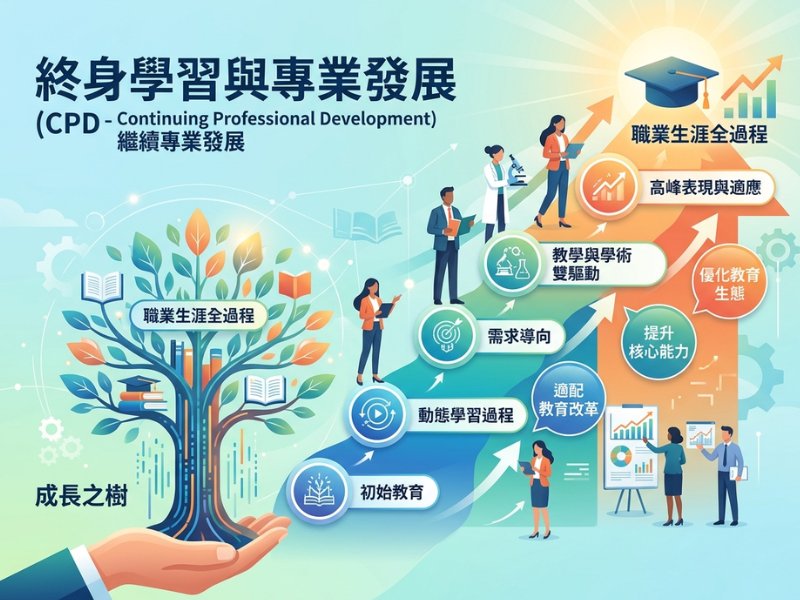
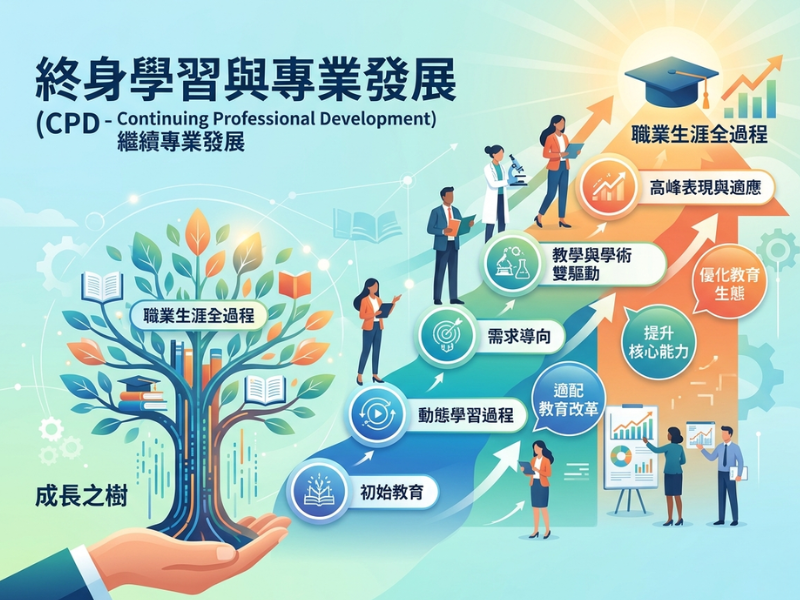
Integrating the views of scholars and authoritative institutions, the core ideas of CPD in education and academia can be summarized into three points: first, "needs-oriented," guided by educational policies, academic frontiers, and student needs; second, "dual-driven," achieving simultaneous improvement in teaching ability and academic level; third, "lifelong," integrating learning throughout one's career.
Compared with CPD in other industries, CPD in education and academia emphasizes "dual-driven teaching and academia." Its core value is reflected in three dimensions:
- Adapting to educational reform needs: Whether it's updates to curriculum standards in basic education or adjustments to academic evaluation systems in higher education, education practitioners need to grasp new policies and methods promptly through CPD to ensure that teaching and research do not detach from industry development. As UNESCO emphasizes, CPD is a key mechanism for the education system to respond to social changes, ensuring that educational quality keeps pace with the times.
- Enhancing core competencies: For teachers, CPD can optimize teaching design, classroom management, and student guidance abilities; for academic researchers, it can strengthen research methods, literature analysis, and成果转化 abilities; for administrators, it can enhance educational planning, team leadership, and resource integration abilities. Research by the British Psychological Society shows that high-quality CPD effectively enhances practitioners' reflective abilities and adaptability, reducing career stagnation.
- Promoting educational ecosystem optimization: Individual CPD accumulation gradually radiates to classrooms, schools, and even the industry, driving improvements in teaching quality and innovation in academic achievements, ultimately benefiting student growth and the progress of the education industry.
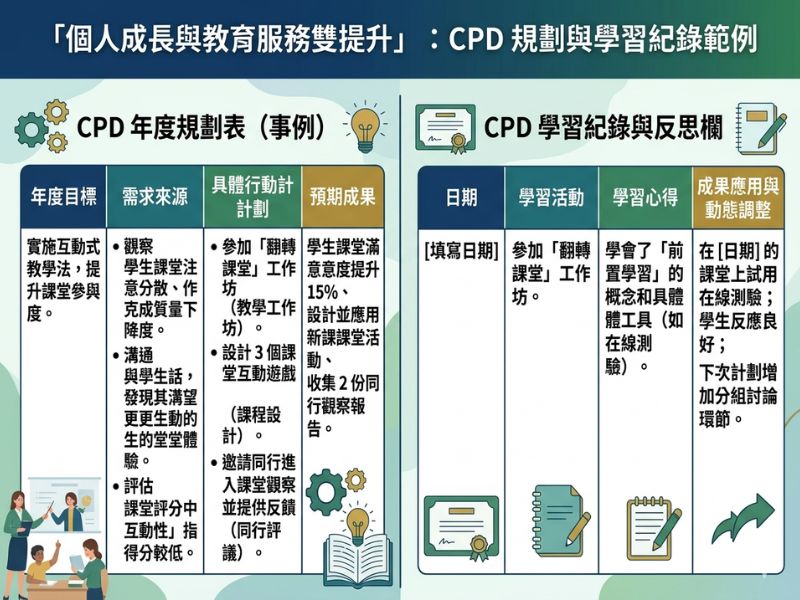
2. Personal CPD Plan Examples for Education Practitioners (Ready to Reference and Reuse)
The core of CPD in education and academia is "planning according to needs"—designing differentiated paths based on one's own role (teacher, researcher, administrator) and stage goals. The following is a general CPD plan table covering common needs of different education practitioners, referencing international CPD practice standards for easy adaptation to one's own situation:
| Start Date | Institution / Organization / Platform | Course Name / Activity | Learning Objective |
|---|---|---|---|
| 2022 | University, College of Education | Teaching Method Innovation and Classroom Design Course | Master new methods such as project-based learning and differentiated instruction, enhance classroom interaction and teaching effectiveness, aligning with UNESCO's emphasis on "contextualized teaching ability." |
| 2022-2023 | National Office for Education Science Planning | Academic Research Methods in Education Workshop | Systematically learn qualitative and quantitative research processes, master literature retrieval and thesis writing skills, responding to Garavan's idea of "dynamic skills update." |
| 2023-2024 | International Association for Education (IQA) | Cross-national Education Comparison and Academic Exchange Conference | Exchange ideas with global education researchers, understand international education前沿 trends, broaden academic horizons, implementing Kennedy's "collaborative CPD" concept. |
| 2024-2025 | Junior Secondary Education Policy Research Center | New Era Education Policy Interpretation and Practice Course | Accurately grasp education policy directions, ensure teaching and research comply with industry standards, enhance policy implementation ability, meeting the CPD Standards Office's requirement for "practical applicability." |
| After 2025 | Senior Secondary Academic Team / Education Research Institute | Key Academic Research Project | Deeply participate in cutting-edge academic projects, accumulate research成果, achieve phased breakthroughs in academic ability, promote collaborative growth of individuals and teams. |
Note: CPD in the education field emphasizes "practice and reflection." Referring to the suggestions of the CPD Standards Office, every practitioner should regularly (e.g., every academic year)梳理 CPD outcomes (teaching cases, research papers, course designs, etc.), share goals and progress with peers, and use feedback to optimize subsequent planning. At the same time, complete learning records and certification certificates should be kept as a basis for career development and qualification认证.
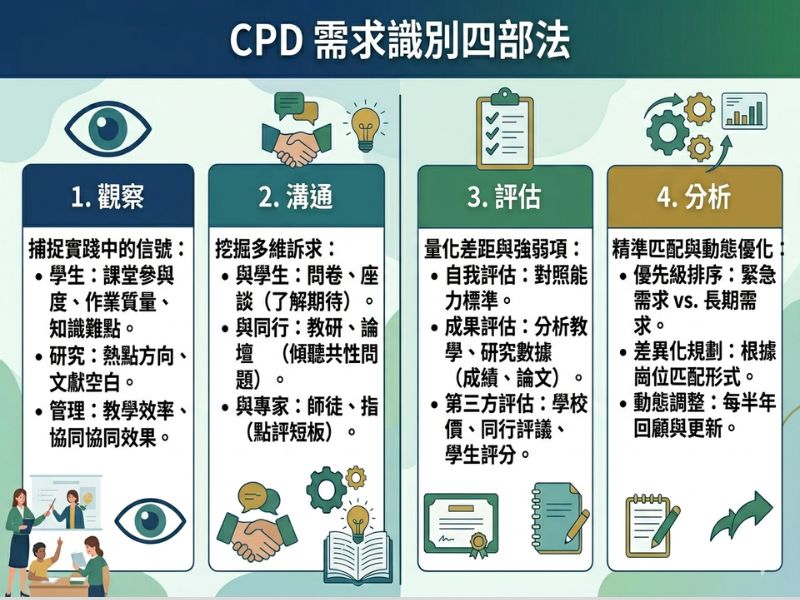
3. Essential for Educators: How to Identify Your Own and Your Learners' CPD Needs
For education practitioners, CPD is not only a need for personal growth but also requires identifying "one's own needs" and "learners' needs" (students, trainees, etc.) to achieve "dual improvement of personal growth and educational service." Combining educational academic contexts and scholars' research findings, here are four core identification methods:
1. Observation
In daily teaching or research, identify gaps through detailed observation, consistent with Kennedy's point that "CPD needs originate from practical observation":
- For teachers: Observe students' classroom participation, homework quality, and difficulties in knowledge absorption to determine whether you need to optimize teaching methods (e.g., for students with low attention, learn "interactive classroom design").
- For researchers: Observe热点 directions in academia, gaps in literature, and identify shortcomings in your own research methods or knowledge储备 (e.g., if quantitative research becomes mainstream in a field, you need to supplement statistical analysis skills).
- For administrators: Observe the team's teaching efficiency and research collaboration effects to determine whether you need to improve organizational planning or resource integration abilities.
2. Communication
Clarify key needs through multi-dimensional communication, which is the foundation for achieving "collaborative CPD":
- Communicate with students: Through questionnaires, forums, etc., understand students' expectations of classroom content and teaching formats (e.g., "hope for more case analysis classes," "need more academic research experience").
- Exchange with peers: During teaching research activities and academic forums, listen to common problems peers face (e.g., "how to design an evaluation system under the new policy") and compare them with your own needs.
- Consult with industry experts: Through mentorship, academic guidance, etc., let experts comment on your shortcomings (e.g., "lack of innovation in research framework") to clarify CPD direction.
3. Assessment
Use scientific assessment methods to objectively定位 the gap between yourself and the需求, ensuring the targeting and effectiveness of CPD:
- Self-assessment: Compare with industry competency standards (e.g., teacher professional standards, academic researcher evaluation indicators) to梳理 your strengths and weaknesses in teaching, research, management, etc.
- Outcome assessment: Analyze your own teaching effectiveness data (student grades, classroom satisfaction) and academic成果 (paper publications, project approvals) to determine which areas need strengthening through CPD.
- Third-party assessment: Obtain objective feedback through school evaluations, peer reviews, student ratings, etc. (e.g., "insufficient classroom interaction," "single research method") to明确 CPD priorities.
4. Analysis
Integrate data from observation, communication, and assessment for分层 analysis, reflecting the "strategic" idea of CPD:
- Prioritize: Distinguish between "urgent needs" (e.g., upcoming new curriculum standards requiring rapid mastery of corresponding teaching methods) and "long-term needs" (e.g., systematic improvement of academic research ability).
- Differentiated planning: Match CPD formats according to your role (teachers can prioritize teaching workshops and course design training; researchers can focus on academic forums and research methods courses; administrators can attend education planning研修班).
- Dynamic adjustment: Educational and academic needs are constantly changing. It is recommended to review CPD implementation every six months and adjust plans according to new needs (e.g., characteristics of new student groups, new academic热点) to ensure synchronization with industry development.
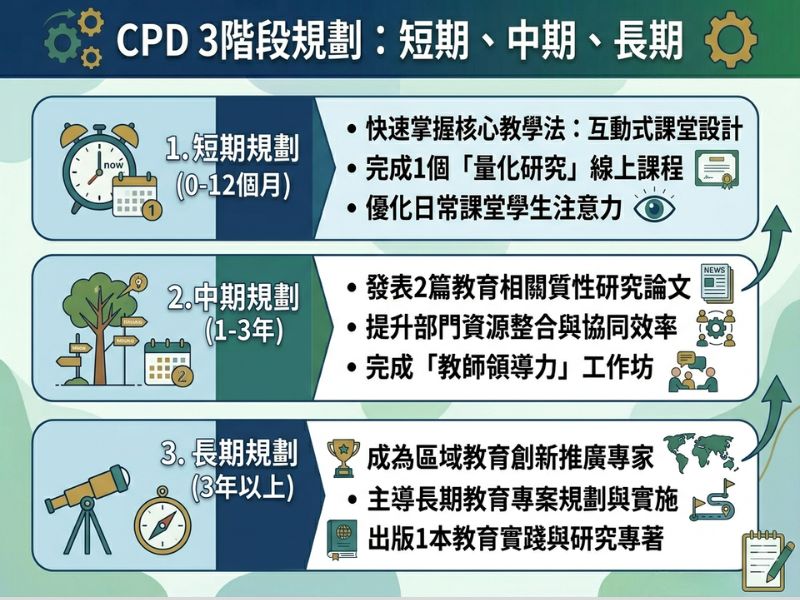
4. CPD Implementation Strategies: Short, Medium, and Long-term Planning Frameworks
The value of CPD lies in "implementation," not just planning on paper. Based on the career lifecycle of education practitioners and industry development规律, the following phased strategies are designed to ensure CPD continuously produces results:
1. Short-term Strategy (1-6 months): Quick Start and Demand Fulfillment
The core of short-term CPD is "small steps, quick runs," focusing on urgent needs and easy-to-implement learning tasks to quickly build a sense of achievement:
- Precise needs diagnosis: Take 1-2 weeks to complete a three-dimensional needs survey of "self-assessment + peer questionnaires + student feedback,"锁定 1-2 core短板 (e.g., "insufficient literature analysis ability," "lack of interactive teaching methods").
- Lightweight learning investment: Choose fragmented, high-return learning formats, such as online micro-courses (preferably from teacher network研修 platforms recognized by the Ministry of Education), reading relevant professional books (specific recommendations in the next section), participating in校内 teaching research salons, investing 3-5 hours per week to avoid giving up due to learning pressure.
- Immediate practice feedback: Quickly apply learning outcomes to teaching or research. For example, after learning a new classroom interaction tool, practice it in next week's class and adjust based on student feedback; after learning literature retrieval skills, use them for literature sorting in the current research project to verify the learning effect.
- Record and reflect: Establish a simple CPD notebook to record learning content, practice scenarios, effect feedback, and improvement directions, accumulating data for medium-term planning.
2. Medium-term Strategy (6 months - 3 years): Capability Integration and Outcome Transformation
The core of medium-term CPD is "systematic improvement," transforming single skills into comprehensive abilities and forming verifiable成果:
- Modular capacity building: Based on needs data accumulated in the short term,确定 2-3 core competency modules (e.g., "teaching design + academic research," "education management + resource integration"), choose deep learning projects such as signing up for offline workshops, participating in cross-school teaching reform projects, or joining academic research teams.
- Visualized outcome output: Form 1-2 quantifiable CPD成果 every 1-2 years. For example, teachers can develop one quality course and publish one teaching reform paper; researchers can apply for one project at various levels and publish 2-3 academic papers; administrators can develop one team development plan and lead one校内 management optimization project.
- Deepening collaborative learning: Implement Kennedy's "collaborative CPD" concept by forming learning communities with peers, conducting collective lesson preparation, joint research, cross-school exchanges, etc., to enhance learning efficiency through brainstorming and resource sharing.
- Upgrading qualification认证: According to industry requirements, participate in authoritative CPD认证 projects, such as UNESCO-recommended international teacher professional development认证 or continuing education programs recognized by domestic education authorities, to enhance the value of qualifications.
3. Long-term Strategy (3+ years): Industry Leadership and Ecological Contribution
The core of long-term CPD is "breakthrough and leadership," rising from personal growth to industry contribution, maximizing professional value:
- Form core competitiveness: Based on medium-term accumulation, create your own "benchmark field," such as becoming an expert in a certain teaching method, an academic leader in a certain research方向, or an innovator in a certain management area, forming a hard-to-replace competitive advantage.
- Academic and practical output: Through publishing high-quality academic papers, publishing monographs, editing textbooks, holding academic lectures, etc.,辐射 your CPD成果 to more peers, promoting overall industry progress.
- Participate in industry construction: Actively participate in education policy discussions, industry standard formulation, CPD course development, etc., such as joining education academic associations, participating in textbook compilation committees, or becoming a CPD trainer, shifting from "passively adapting to the industry" to "actively leading the industry."
- Mentorship and driving: Leverage the driving role of senior practitioners to guide young teachers or researchers in CPD planning, form research teams or teaching innovation teams, creating a virtuous cycle of "personal growth → team improvement → industry optimization."
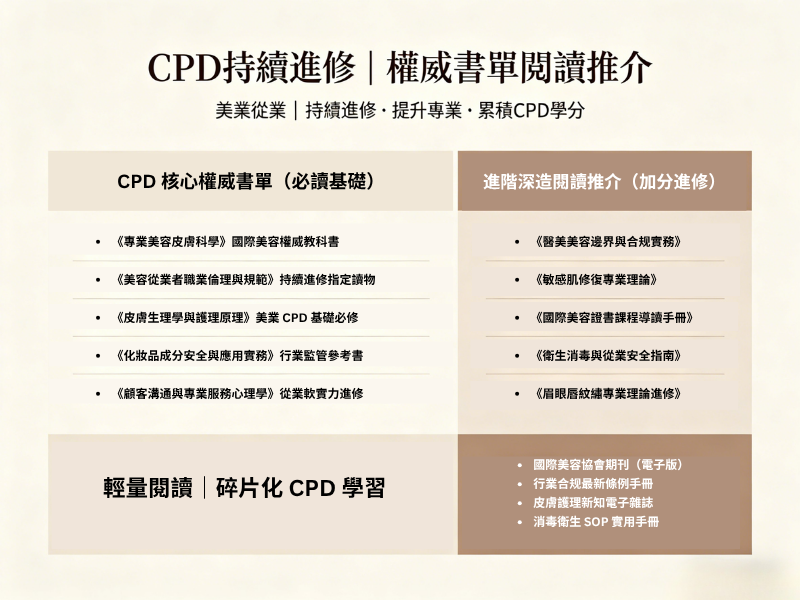
5. Recommended Must-Read Books on CPD: Authoritative References from Theory to Practice
Reading is one of the basic forms of CPD. Here are 6 authoritative books covering CPD theory, educational practice, and academic research to help education practitioners systematically grasp the core ideas and implementation methods of CPD:
- Continuing Professional Development: A Guide for Educators
Authors: David Garavan, Aileen Kennedy
Core content: This book, co-authored by authoritative scholars in the CPD field, systematically expounds the definition, theoretical origins, implementation framework, and evaluation standards of CPD in education. It integrates decades of research成果 and practical experience from the two scholars. The book contains numerous CPD cases in educational settings, such as how teachers optimize classroom teaching through CPD and how researchers improve research quality through CPD. It also provides ready-to-use CPD planning tool tables, making it a foundational reading for education practitioners embarking on CPD. - Teacher Professional Development: Theory and Practice
Authors: Andy Hargreaves, Michael Fullan
Core content: This book focuses on the CPD needs of teachers, proposing a "learning community-based CPD model" that emphasizes that teacher professional development should not be孤立 but realized through team interaction and practical reflection. The book deeply analyzes the CPD characteristics and needs of teachers at different stages, provides differentiated CPD paths for novice, backbone, and senior teachers, and includes practical tools such as teaching reflection diaries and teaching research activity designs, suitable for teachers at all stages. - CPD for Academic Research: From Beginner to Expert
Author: Juliet Robinson
Core content: This book专门 focuses on the CPD needs of academic researchers, systematically explaining how to enhance academic capabilities through CPD from dimensions such as research methods, literature analysis, project applications, and成果 publication. The book contains numerous real academic research cases, analyzing the dilemmas faced by researchers at different stages and corresponding CPD solutions, and provides practical paths for transforming academic成果, suitable for university teachers and researchers. - Continuing Professional Development in Educational Management
Author: Patricia Bolton
Core content: This book addresses the CPD needs of education administrators (principals, teaching research directors, department heads, etc.), focusing on core competencies such as educational planning, team management, resource integration, and policy implementation, proposing a "managerial CPD" implementation framework. The book contains numerous school management cases, such as how to optimize teacher team building through CPD and how to formulate long-term school development plans, and provides management能力 assessment tools and CPD planning templates, making it a must-read for education managers. - UNESCO Handbook for Teacher CPD Implementation
Compiled by: UNESCO Institute for Education
Core content: This authoritative guide, compiled by UNESCO based on global education CPD practices,汇集 outstanding CPD cases from different countries and regions, such as Finland's teacher CPD model and Singapore's education administrator CPD system. The book clarifies the core standards and implementation paths for high-quality CPD and provides toolkits for CPD project design, evaluation, and improvement, with strong international perspectives and practical reference value. - Reflective Practice and CPD: A Pathway for Educators' Growth
Author: Claire Holden
Core content: This book combines "reflective practice" with CPD, emphasizing that reflection is a core part of CPD. By guiding education practitioners to engage in teaching reflection, research reflection, and management reflection, it achieves continuous capability improvement. The book provides various reflection tools, such as reflection diary templates, peer review forms, and practice improvement flowcharts, helping readers transform passive learning into active growth, suitable for all education and academia practitioners.
6. Conclusion: CPD is the "Long-term Competitive Advantage" for Education and Academia Practitioners
In today's education industry, where "high-quality development" is emphasized, CPD is no longer an "option" but the core confidence for education practitioners to "avoid being eliminated and achieve continuous breakthroughs." As Garavan emphasized in his research, CPD is not a simple supplement of knowledge but a "strategic investment in one's career," whose value lies not only in personal能力提升 but also in promoting the overall progress of the education industry.
Unlike the "emergency improvement" of short-term training, CPD emphasizes "systematic accumulation"—it is not a one-time task but a "lifelong learning practice"贯穿 throughout one's career. UNESCO research data shows that education practitioners who continuously participate in high-quality CPD have teaching innovation capabilities and academic成果 output that are more than 60% higher than those who do not participate, fully confirming the core value of CPD.
For education practitioners, doing a good job in CPD planning requires not only clarifying "why to learn" but also determining "what to learn," "how to learn," and "how to implement." A quick start in the short term, systematic accumulation in the medium term, industry leadership in the long term,再加上 the theoretical support of authoritative books, can help every education practitioner build their own CPD system. May every education and academia practitioner, guided by scientific CPD planning, continuously break through on the educational and academic path, not only realizing personal value but also fulfilling the educational mission, ultimately promoting the high-quality development of the entire educational ecosystem.
This article is organized by the Education & Academia Research Centre of LBEDU Luster Beauty International Education & Training Academy (King Lun Lawrance WONG).
Comments (0)
No comments yet
Leave a Comment