VTCT Skills ITEC International SMP Scalp Micropigmentation Certificate Course (UK / European Qualifications Framework Level 4) | Hong Kong Scalp Micro Pigmentation, Hair Loss & Scar Camouflage, Internationally Recognised Micropigmentation Qualification
[Course Objectives]
This unit aims to develop learners’ professional knowledge, understanding and practical skills in scalp micropigmentation (SMP) techniques. SMP is a form of cosmetic tattooing used to replicate the appearance of natural hair follicles and a closely shaved haircut, or to camouflage scars, areas of hair thinning or hair loss on the scalp. The course covers skills in conducting thorough consultations to determine client suitability, and knowledge of creating personalised treatment plans tailored to individual client needs and requirements. Learners will also master the knowledge required to provide pre-treatment and post-treatment advice, aftercare guidance and maintenance treatment plans, ensuring clients receive full treatment benefits and maintain long-term optimal results.
[Learning Hours & Course Duration]
| Item |
Details |
Remarks |
| Total Course Hours |
21 Hours |
Divided into theory and practical components with hands-on training in simulated environment |
| Study Duration |
1 Month |
Intensive short-term course to quickly master professional SMP techniques |
[Entry Requirements]
- Aged 18 or above
- Form 3 secondary education or equivalent qualification
- Fluent in Cantonese, Mandarin or English for effective client consultation communication
[Course Syllabus]
1. Environment & Safety Guidelines for SMP Scalp Micropigmentation Treatments
- Sustainable working practices for environmentally responsible operations
- Licensing regulations for beauty practitioners and business premises
- Professional indemnity insurance guidelines
- Safe procurement standards for products and equipment
- Safety selection guidelines for suppliers and manufacturers
- Service delivery in accordance with organisational procedures
- Hygiene considerations and standard infection control protocols
- Identification of contraindications and conditions requiring restricted treatment
- Criteria for conditions requiring medical referral
- Timing and procedures for cross-consultation with other beauty/medical professionals
- Protocols for handling underage clients
- Hazard identification and treatment risk assessment
2. Protocols and Guidelines for SMP Scalp Micropigmentation Treatments
- Key considerations when formulating treatment plans
- Assessment methods for scalp, hair texture, hair loss conditions and skin characteristics
- Standard pre-treatment and post-treatment advice for clients
- Treatment duration planning and session scheduling
- Pain levels, sensitivity variations and patch testing methods
- Pre-treatment scalp, hair and skin preparation plans
- Types and applications of SMP equipment, products and techniques
- Selection and preparation procedures for treatment equipment and products
- Benefits and applications of topical numbing agents
- Standard operating techniques and step-by-step procedures
- Treatment indications and suitability explanation
- Uses, limitations, benefits and expected results of SMP scalp micropigmentation
- List of treatment-related contraindications
- Recommendations for SPF and UVA-specific sunscreen use
- Infection prevention and wound healing promotion methods
- Treatment progress tracking and recommendations for top-up / supplementary sessions
3. Consultation, Planning and Preparation for SMP Treatments
- Using professional consultation skills to confirm client treatment plans
- Communicating and negotiating treatment plans with clients
- Assessing actual condition of skin, scalp, hair and hair loss
- Explaining treatment procedures and expected results to clients in detail
- Developing pre-treatment skin / hair preparation regimens
- Standard procedure for pre-treatment photography documentation
- Procedures for conducting skin sensitivity patch tests
- Logic for selecting appropriate equipment and products
- Cooling-off period explanation and client informed consent process
4. Practical Delivery of SMP Scalp Micropigmentation Treatments
- Personal responsibility for maintaining health and safety throughout treatment
- Methods to protect both client and practitioner during procedures
- Upholding client dignity and privacy at all times
- Ensuring all equipment, products and materials meet cleaning and disinfection standards
- Safe operating protocols for equipment, materials and products
- Equipment selection criteria
- Needle size and configuration selection logic
- Pigment shade selection and colour matching techniques
- Pre-treatment skin cleansing and disinfection preparation
- Systematic delivery of full SMP scalp micropigmentation treatment
- Monitoring skin reactions and client tolerance levels
- Application methods for post-treatment repair products
- Standard procedure for post-treatment photography documentation
- Providing aftercare advice and home care guidance
- Legal medical waste disposal procedures
- Standards for updating client treatment records
[Examination & Graduation Requirements]
| Item |
Requirement |
Remarks |
| Attendance Requirement |
Minimum 70% |
Required to be eligible for the final summative assessment |
| Assignment Requirement |
Completion of case study assignments |
Internal assessment component |
| Examination Format |
Mock exam + Summative assessment (Theory + Practical) |
Covers all units of the course syllabus |
| Passing Score |
60% or above |
Certificate awarded upon meeting the passing standard |
[Assessment Fees]
- All in-course assessment fees are fully waived and included in the tuition fee, with no hidden extra charges
- VTCT (iTEC) Level 2 Award in Infection and Prevention certificate can be added at extra cost, fee from HK$800+
[Exclusive Student Benefits]
- Lifetime online course Q&A support, with tutors available to answer technical and industry business queries at any time
- Access to wholesale discount channels for international beauty brands, reducing supply costs for business startups
- Eligibility to attend the annual grand graduation ceremony, with graduation gown and cap provided for photo opportunities
- Eligibility to join major international beauty competitions overseas to build professional portfolio
- Regular overseas beauty study tours, visiting international beauty exhibitions and overseas academies
- Free booking of on-campus professional beauty treatment rooms and beds for extra practice
- Free lifetime course refresher access for all graduates
- Job referral and teaching assistant opportunities for outstanding performing students
[Certificates Awarded]
| Certificate Title |
Awarding Body |
| VTCT (ITEC) Level 4 AWARD in Scalp Micropigmentation Treatments |
UK VTCT (iTEC) |
| LBEDU Academy Level 4 AWARD in Scalp Micropigmentation Treatments |
LBEDU Academy |
[Accreditation & Recognition]
- Official UK qualification recognition by VTCT (iTEC)
- Professional academy qualification recognition by LBEDU Academy
[Additional Professional Qualifications (Available at Extra Cost)]
Upon course completion, graduates may enrol in the following professional examinations at their own expense to obtain further international qualifications:
- HKQF-Certificate in Semi-Permanent Micro-Pigmentation (QF Level 3)
- UK City and Guilds Assured Certificate in Micropigmentation
- Korea IFBC Certificate in Scalp Micropigmentation
- Korea SISA Certificate in Scalp Micropigmentation (Eligible to apply for SISA Vice President position upon course completion)
- Hong Kong IQA Certificate in Micropigmentation
[Progression / Other Courses]
Upon graduation, students may enrol in the following professional courses to obtain additional industry qualifications:
Level 2 Progression Courses
Level 3 Progression Courses
Level 4 Progression Courses
Level 5 Progression Courses
History of ITEC - Founded in 1947
What is iTEC?
iTEC stands for the International Therapy Examination Council, and the name has been officially in use since 1973.
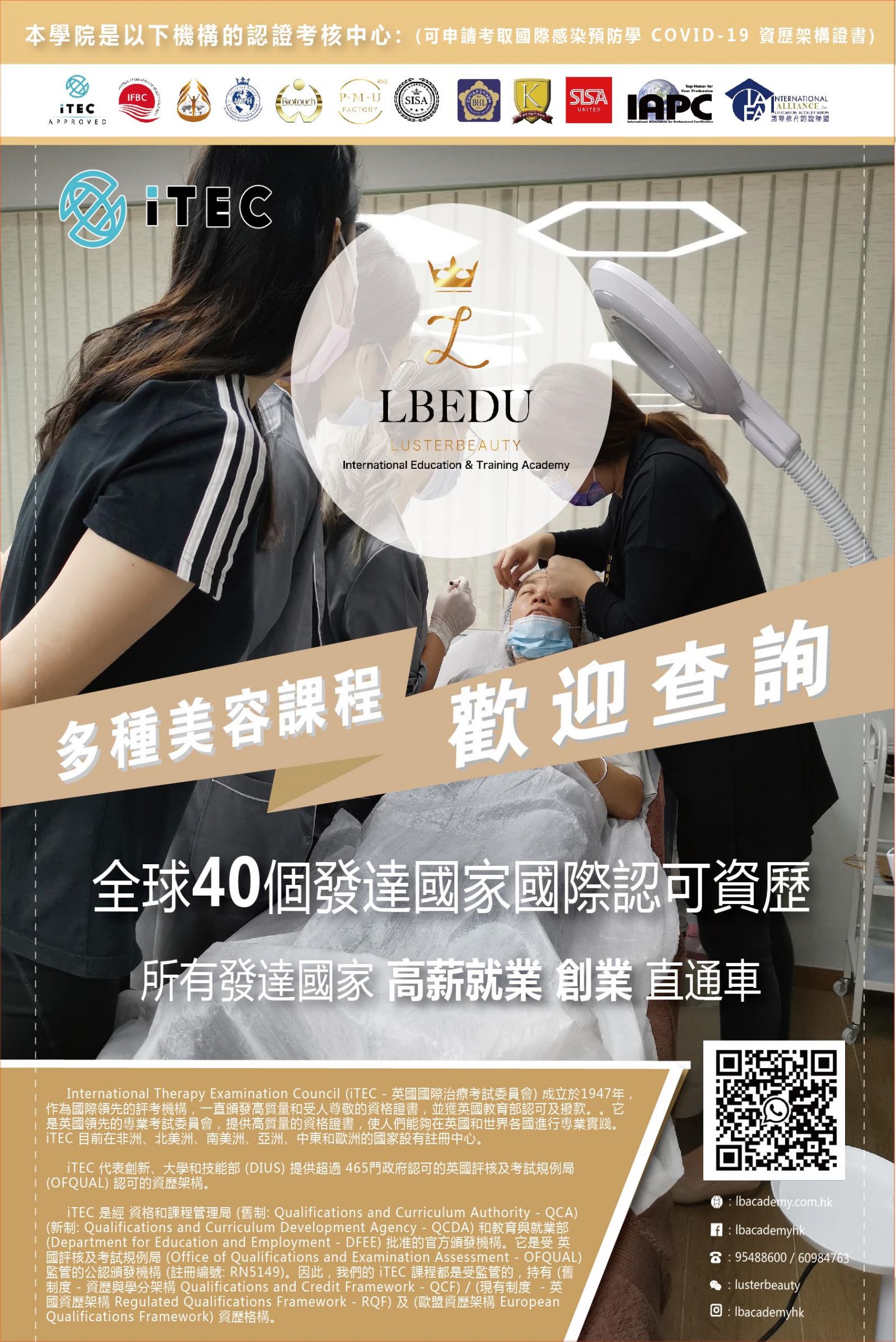
The International Therapy Examination Council (iTEC) was founded in 1947. As a world-leading awarding body, it has long issued high-quality and highly respected qualifications, recognised and funded by the UK Department for Education. It is a leading professional examination board in the UK, providing high-quality qualifications that enable holders to practise professionally in the UK and around the world. iTEC currently has registered centres across Africa, North America, South America, Asia, the Middle East and many European countries.
On behalf of the UK Department for Innovation, Universities and Skills (DIUS), iTEC offers over 400 qualification framework courses recognised by both the UK government and the EU, regulated by the Office of Qualifications and Examinations Regulation (OFQUAL).
iTEC is an official awarding body approved by the Qualifications and Curriculum Authority (QCA, former department) / Qualifications and Curriculum Development Agency (QCDA, current department) and the Department for Education and Employment (DFEE). It is a recognised awarding body regulated by the Office of Qualifications and Examinations Assessment (OFQUAL), with registration number RN5149. All iTEC courses are therefore officially regulated, aligned with the former Qualifications and Credit Framework (QCF), the current Regulated Qualifications Framework (RQF) and the European Qualifications Framework (EQF) levels.
iTEC ensures that the syllabus for every qualification reflects workplace best practices, and each course is mapped to relevant job roles, guaranteeing that syllabus content fully matches the knowledge and skill levels required by practising therapists.
iTEC diploma qualifications are highly valued by employers. The industry widely recognises that an iTEC qualification represents solid theoretical knowledge, strong practical ability, and a rigorous independent examination process.
Courses follow the latest iTEC QCF (Qualifications and Credit Framework) syllabus introduced by the UK government in September 2009 and revised in September 2012. This means that if a national mandatory regulator for complementary medicine is established by the government in the future, holders’ qualifications will be automatically recognised. In addition, the qualification can be used to apply for roles in the UK National Health Service, and course credits can be transferred towards university degree programmes.
Upon successful completion of an iTEC course, holders may apply to join the Complementary & Natural Healthcare Council, a voluntary regulator established by the UK Department of Health.
CNHC Complementary & Natural Healthcare Council - iTEC Course Statement - Click to Download
iTEC International Qualifications
iTEC works in close partnership with VTCT, with over 1850 registered colleges worldwide, and offices and representatives in London, Ireland, the USA, South Africa and the Asia-Pacific region. iTEC provides regulated high-quality qualifications for registered centres and learners, enhancing employability, subject expertise and skill levels. iTEC’s qualification portfolio covers a wide range of sectors including beauty & spa, complementary therapies, sport & fitness, hairdressing & beauty, and customer service.
High Quality & Highly Regarded Industry Qualifications
iTEC provides world-leading professional qualifications specialising in beauty & spa therapy, aesthetics, complementary therapies, sport & fitness training and customer service, present in over 40 countries worldwide including the UK, USA, Canada, Australia, New Zealand, Japan, Hong Kong China and across Europe.
iTEC (VTCT) courses effectively enhance career opportunities in the beauty industry for both local students and those planning to migrate overseas.
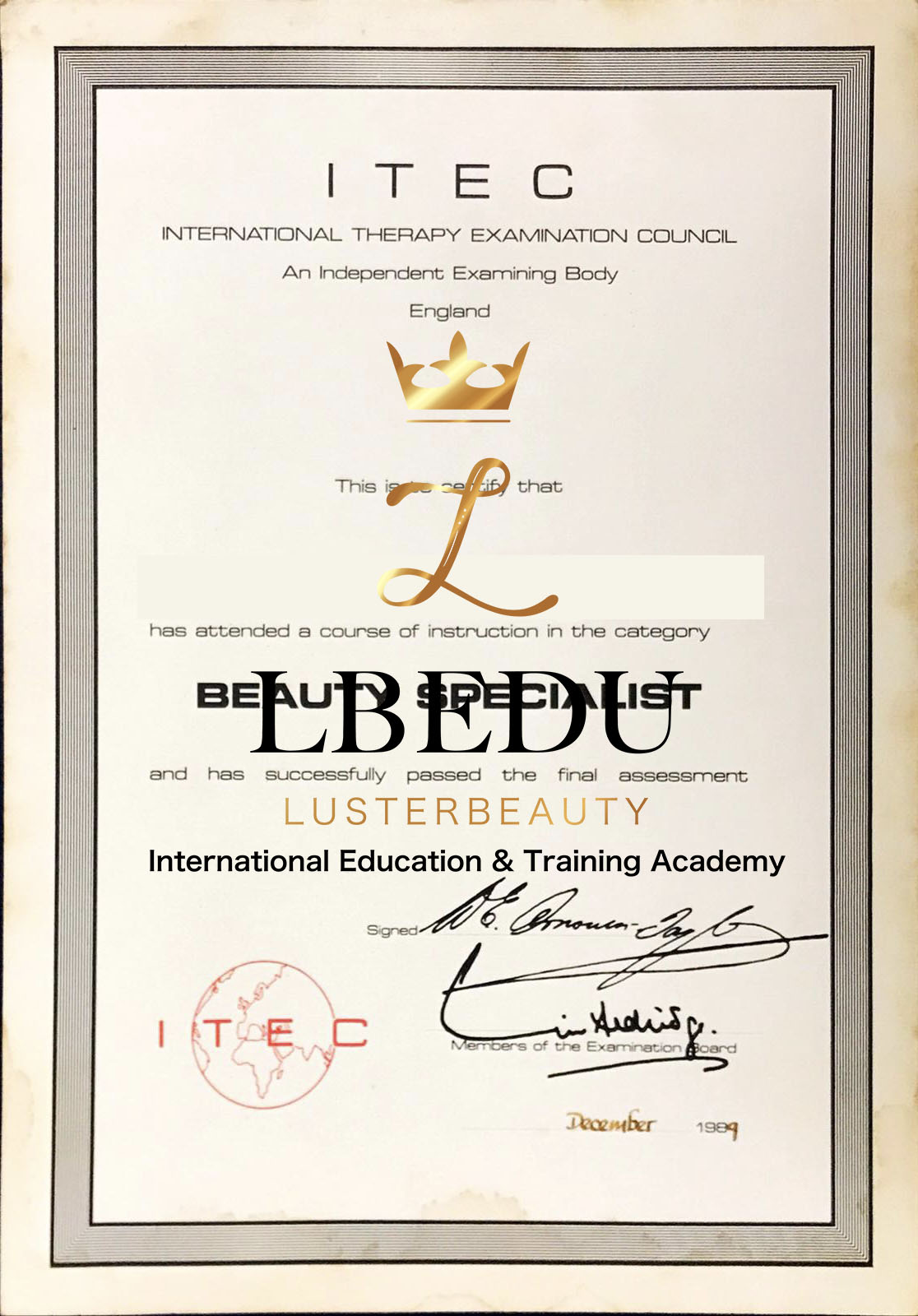
History of iTEC Qualification Training - Historical iTEC Certificate from 1989
As a Leading Awarding Body, iTEC and VTCT are Committed to the Highest Standards for Centres and Learners
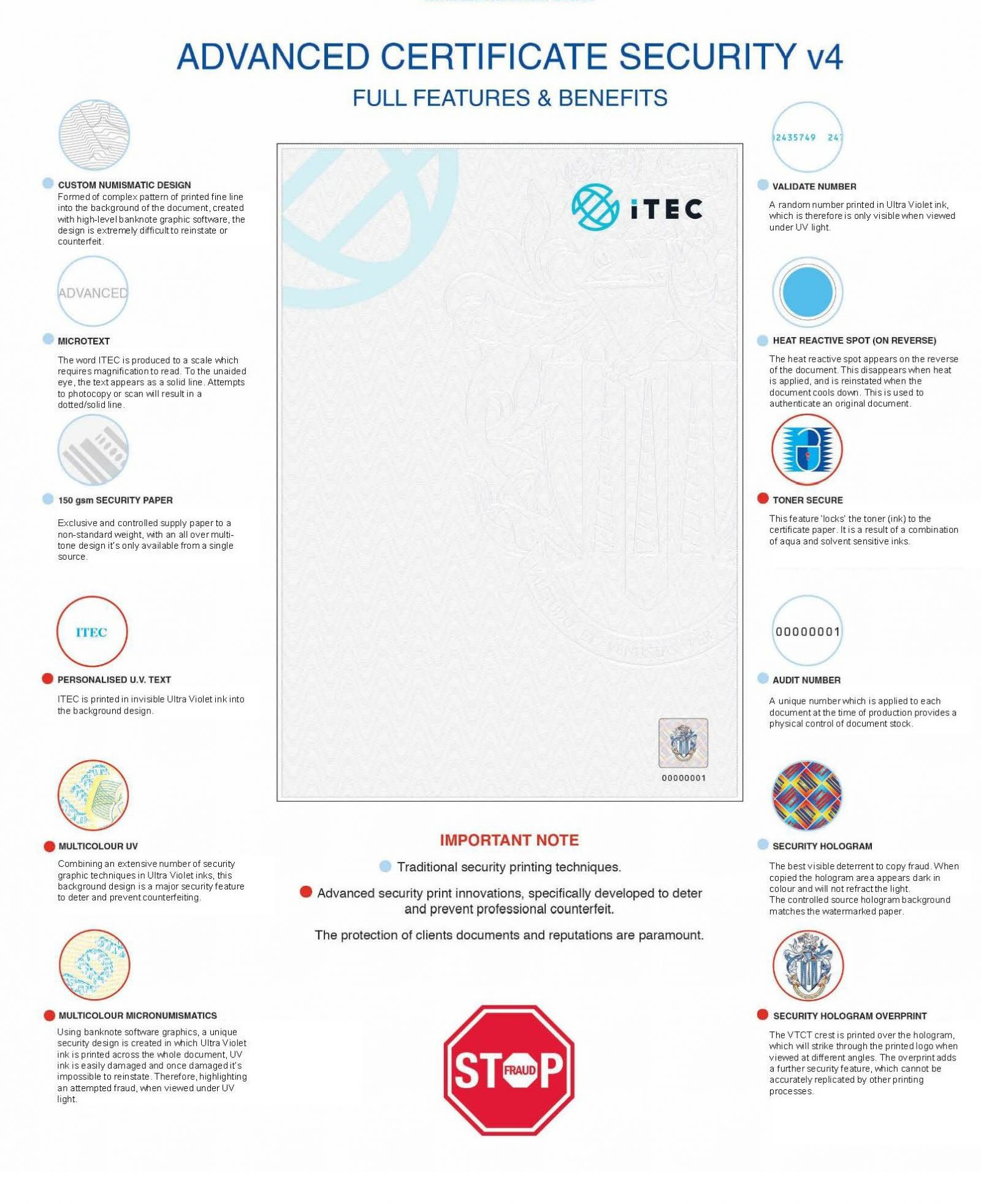
To this end, the organisation continuously invests in enhancing the anti-counterfeiting security of iTEC and VTCT certificates. In recent years, iTEC and VTCT underwent a brand rebranding, and certificates have been redesigned accordingly, featuring new brand identity and upgraded security features.
Features of the new certificates include:
- High-quality security paper: significantly increasing difficulty of forgery and alteration
- Personalised UV invisible text: iTEC and VTCT wording is printed in invisible UV ink within the background design of every certificate
- Security hologram: certificates feature highly visible anti-copy holographic security labels
- Microtext: iTEC and VTCT wording is reduced to a size only readable under magnification, appearing as a solid line to the naked eye
The organisation is committed to ensuring that all rebranding reflects its core values, and as a professional body, believes that providing learners with high-quality, secure and reliable certificates is a core responsibility.
iTEC International Therapy Examination Council Certificate Sample
- Ofqual = Office of Qualifications and Examinations Regulation, UK
- RQF = Regulated Qualifications Framework, UK
- EQF = European Qualifications Framework
- VTCT = Vocational Training Charitable Trust, UK
Frequently Asked Questions
Q1: Can I enrol if I have no prior micropigmentation experience?
A: Yes. The course is taught progressively from basic theory and equipment operation to full practical procedures, with practice in a simulated environment, so complete beginners can systematically learn SMP techniques.
Q2: What are the main applications of SMP scalp micropigmentation?
A: SMP can be used to create visual density for male pattern baldness, diffuse hair loss and receding hairlines. It can also camouflage scalp scars, burn scars, or thinning parting areas, creating the visual effect of short hair follicles.
Q3: Are there separate exam fees to pay?
A: The core SMP assessment fees are waived and included in the tuition fee, with no hidden charges. The Level 2 Infection Prevention certificate can be added at extra cost based on individual needs.
Q4: What career options are available after graduation?
A: Graduates may work in specialist SMP studios, men’s barbershops, medical aesthetic centres and hair loss treatment clinics, or start their own SMP specialist service business. There are wide employment and entrepreneurship pathways.
Q5: How long does the course take to complete?
A: The total course duration is 21 hours, with a standard study period of 1 month. Students will graduate and receive their certificates upon completing all assignments and passing the theory and practical examinations.
Q6: Is the VTCT Level 4 SMP certificate recognised in Hong Kong?
A: Yes. VTCT (iTEC) is a UK Ofqual-regulated awarding body. The qualification is widely accepted by the beauty industry in Hong Kong and over 40 countries worldwide, with credibility for both employment and business setup.
Q7: What are the entry requirements?
A: The minimum entry requirement is aged 18 or above, with Form 3 or equivalent education, and conversational proficiency in Cantonese / Mandarin / English. No prior beauty or micropigmentation experience is mandatory.