- Key conclusion: face paint and body painting sit in the same group of competency units under the HKQF Beauty Industry SCS within the "Make-up" functional area — qualifications recognise competency, not body area; face paint is simply body painting on a smaller area.
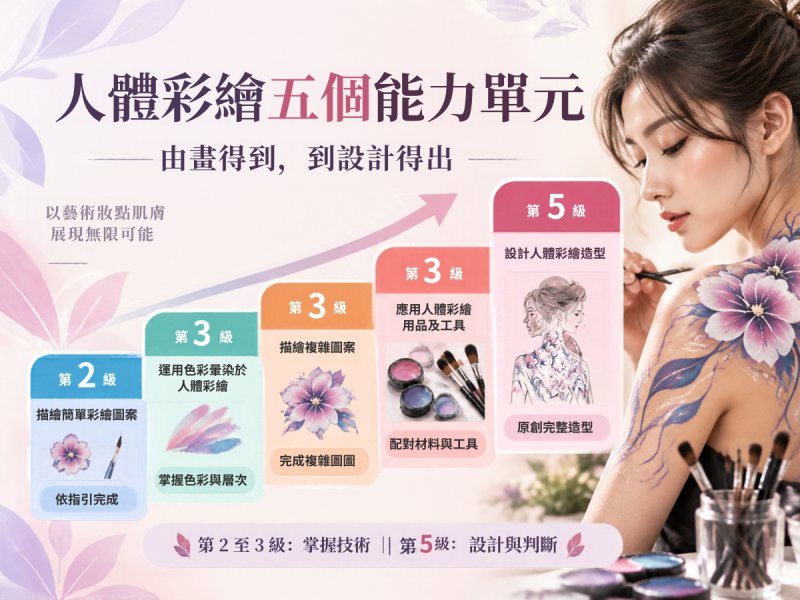
- Five units: (Draw simple body painting patterns, Level 2), (Apply sfumato to body painting, Level 3), (Draw complicated patterns, Level 3), (Use body painting materials and tools, Level 3), (Design body painting images, Level 5, 9 credits).
- The key difference: the units prove "you can paint"; a tutor qualification proves "you can teach" — technical and teaching competence are two different standards, the latter covering course design, assessment and classroom safety.
- Tutor route: Beauty Industry Teaching and Training Certificate (HKQF Level 3), course code CTPT3, QR registration 26/000912/L3, 15 QF credits, institution number 854 — as at November 2026 the only HKQF-recognised body painting tutor route.
- Course structure: 67 hours over 3-4 months across seven parts — tutor duties and professional conduct, identifying learner needs, teaching techniques, facilitating group learning, practical training techniques, assessment of learning, and self-review and course evaluation.
- Fees and funding: HK$15,000 in 3 instalments (HK$5,000/month), listed under CEF with up to HK$11,500 reimbursement, pay as little as HK$3,500; assessment fee waived and practice tools included.
- International comparison: HKQF has completed level comparability with EQF, Ireland, Scotland and New Zealand — HKQF Level 3 = EQF Level 4; this is a level-mapping relationship and does not confer automatic overseas licensing.
Face paint = body painting under HKQF: five competency units (BEZZMU209A-BEZZMU501A). Level 3 CTPT3 teaching certificate, 67 hours, HK$15,000, HK$3,500 after CEF. Tutor route explained.
Face Paint Tutor Career 2026-2027 | Face Paint = Body Painting: Both Sit in the Beauty Industry Make-up Domain
1. What kind of business is face paint, and why do so many want to teach it?
In Hong Kong, demand for face paint is not concentrated on stage. It is scattered across settings that look unrelated to one another: shopping-mall family events, birthday parties, school fairs, corporate family days, themed restaurants, wedding welcome areas, market stalls, and the Halloween and Christmas seasons. What these settings share is a simple requirement — an organiser needs someone who can paint a large number of faces quickly without making a child or a guest uncomfortable.
Once a painter has enough of this work, two thoughts usually appear. The first is to run classes. The second is to become a tutor that institutions will book. The first only needs someone willing to pay. The second needs a qualification that evidences teaching capability, because when an institution buys training services it normally asks the tutor for proof of qualification as the basis for quality assurance.
The problem sits here: many people paint well, but do not know that "tutor" has a formal qualification route in Hong Kong, and do not know that face paint is not classified as "face painting" in the Qualifications Framework at all — it falls under the body-painting competency units of the beauty industry.
Three common misalignments
- Assuming there is a "face paint certificate": no stand-alone award is named after face paint in the Qualifications Framework; the relevant capability sits inside five body-painting units
- Assuming good painting means you can teach: technical and teaching capability are two separate standards — one is about execution, the other about course design, assessment and classroom management
- Assuming the tutor certificate is only for salon work: the certificate spans the whole beauty industry capability map, and body painting is only one item within it, so painters are eligible to enrol
2. Face paint = Body painting: both sit in the beauty industry's Make-up domain
The Hong Kong Qualifications Framework (HKQF) was established by the Academic and Vocational Qualifications Ordinance (Cap. 592), fully implemented on 5 May 2008, and is organised into seven levels. For each industry, the trade draws up a Specification of Competency Standards (SCS), which breaks the industry's functions into individual "competency units", each with a code, a level and a credit value.
The beauty industry SCS is drawn up by the Beauty Industry Training Advisory Committee. Its functional domains include make-up, nail and hand-foot care, beauty therapy, body therapy, aesthetic devices and so on. The function that face paint corresponds to is body painting, sitting under the Make-up domain.
This section first deals with the naming problem, because it is the most common source of confusion. In daily trade language, "face paint" means painting cartoons, animals and seasonal effects on the face, while "body painting" means painting shoulders, back, arms and legs. The market treats them as two services, but in the framework's classification there is no line between them.
The reason is that the SCS divides units by knowledge and skill structure, not by body area. Face painting and body painting share one capability set: positioning a composition on a curved surface, blending and transitioning colour, building three-dimensional form, controlling adhesion and removal of pigment, and managing skin compatibility and hygiene. Technique that is stable on a face only needs adjustment of area and time when moved to a back — it does not become a different discipline. That is why the framework does not create a separate trade for face paint, nor a separate certificate for body painting: both are served by the same body-painting competency units.
| Term used | Typical setting | Units most directly engaged | Framework filing |
|---|---|---|---|
| Face paint / face painting | Birthday parties, mall family events, school fairs, seasonal effects | BEZZMU209A, BEZZMU307A, BEZZMU308A | Beauty industry · Make-up domain · Body painting |
| Body painting | Stage, photography, showcase, themed creative work, large events | BEZZMU308A, BEZZMU311A, BEZZMU501A | Beauty industry · Make-up domain · Body painting |
| Shared by both | Materials, skin safety, composition and colour | BEZZMU311A (products and tools) | Beauty industry · Make-up domain · Body painting |
Put more plainly: face paint is body painting on a small surface; body painting is face paint on a large surface. The framework recognises capability, not area. Once that is clear, the question is no longer "is there a face paint certificate" but "which competency units does this certificate map to".
This conclusion matters because it settles two things. First, a face painter's identity within the qualification system is a technician in the Make-up domain, not a separate trade, so any progression runs along the make-up and beauty qualification structure. Second, when a painter moves into teaching, what is needed is a teaching qualification that spans the whole beauty industry, not a class in painting technique.
(Unit titles above are translated from the Chinese SCS for readability; the authoritative wording is the Chinese text published by the Qualifications Framework Secretariat.)
| Layer | Content |
|---|---|
| Statutory basis | Academic and Vocational Qualifications Ordinance (Cap. 592), fully implemented 5 May 2008 |
| Industry standard | Beauty Industry Specification of Competency Standards, drawn up by the trade, covering make-up, nail and hand-foot care, beauty therapy and other domains |
| Functional domain | Make-up (bridal and occasion, fashion and photographic, personal image design, stage and special effects, film and television, make-up styling, body painting) |
| Competency units | Five body-painting units, from Level 2 to Level 5, each with its own code and credit value |
| Qualification | Assembled by an institution from competency units, recognised, then entered on the Qualifications Register — for example the Certificate in Beauty Industry Teaching and Training (Level 3) |
3. The five competency units, level by level: from "can paint" to "can design"
Body-painting capability is not a flat surface but a ladder. The five units sit at different rungs, and once the ladder is clear, it becomes obvious why "I can paint a cartoon" and "I can design a themed body-painting look" are two different things in qualification terms.
One detail is worth noting: the titles and performance requirements of all five units take "the human body" as the working surface. Not one of them specifies "face only" or "body only". That is the most direct evidence that, in the eyes of the framework, face paint and body painting were never two subjects — they are one capability set applied to different surface areas.
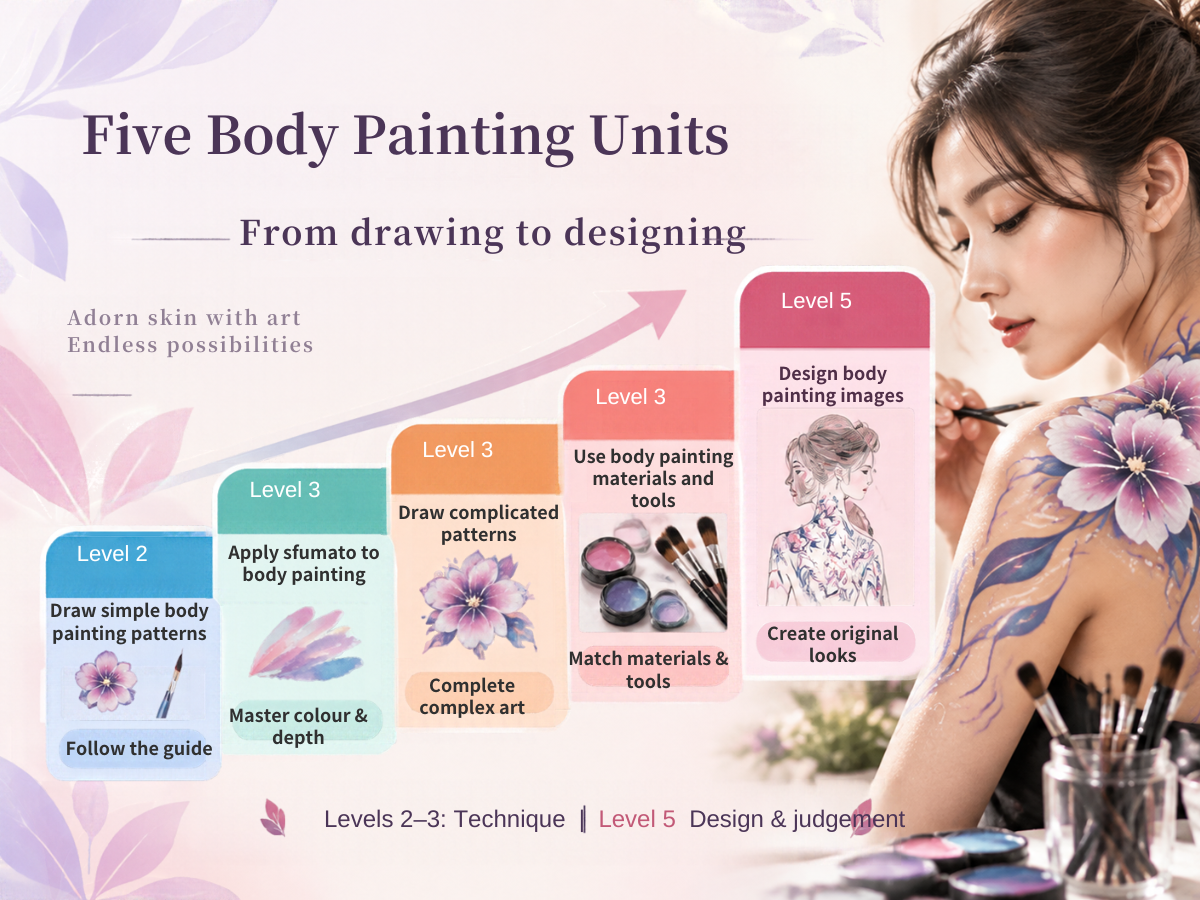
Read side by side, a pattern appears: Levels 2 and 3 deal with "how to achieve it", Level 5 deals with "why it is done this way". The first is technique, the second is design and judgement. A tutor's job requires both at once — and requires being able to break that judgement down into steps a learner can follow.
4. Why "can paint" does not equal "can teach"
A painter who can produce a beautiful unicorn on a child's cheek, standing in front of a class of twenty, will usually meet four problems — and none of them lies within the scope of any technical unit.
Four gaps between technique and teaching
- Cannot decompose the action: painting flows because the hand has memorised it. To teach it, a fluid motion must be broken into steps that can be observed and imitated
- Cannot read learning needs: in one class, someone has a steady hand but cannot match colour, while someone else composes well but cannot control line weight. A tutor must diagnose this before the course starts, instead of teaching everyone the same content
- Cannot assess outcomes: "does it look good" is subjective. A tutor needs observable criteria — whether line closures meet, whether colour transitions read naturally, whether the composition stays inside its intended boundary
- Cannot manage the room and safety: face painting involves skin contact, pigment sensitivity and hygiene procedure. A tutor is responsible for the safety of the whole class, not just for their own pair of hands
These four gaps are exactly the skeleton of the Certificate in Beauty Industry Teaching and Training. Its seven parts — tutor roles, professional conduct and the learning environment; identifying learner needs; teaching techniques; facilitating group learning and development; practical training techniques; assessment of learning outcomes; self-review and course evaluation — map onto the four problems one by one.
In other words, the certificate does not teach you "how to paint better". It teaches you "how to make someone else able to paint, and to know why you teach it that way".
5. The only HKQF-recognised route to a body-painting tutor qualification
As of November 2026, a check of the Qualifications Register shows only one tutor qualification in Hong Kong that takes the beauty industry — including make-up and body painting — as its teaching subject and is recognised under the Qualifications Framework: the Certificate in Beauty Industry Teaching and Training (HKQF Level 3).
That sentence needs precise reading. It does not mean "only this certificate may be used to teach painting" — anyone may run a class. It means: if you want a tutor qualification that is entered on the Qualifications Register, verifiable by institutions, schools and employers, and whose coverage explicitly includes body painting, there is at present only this one.
"Government-regulated" has a specific meaning here, carried by three elements: the course must be recognised by the Hong Kong Council for Accreditation of Academic and Vocational Qualifications under the Academic and Vocational Qualifications Ordinance; once approved it is entered on the Qualifications Register with a stated level and credit value; and its learning outcomes must map to designated competency units in the SCS. Together these three constitute the basis for the phrase — it does not mean the course is run by the government.
| Item | Detail |
|---|---|
| Course | Certificate in Beauty Industry Teaching and Training (HKQF Level 3) |
| Course code | CTPT3 |
| Qualifications Register no. | 26/000912/L3 |
| Level/credits | Level 3; 15 QF credits |
| Institution code | 854 |
| Hours | 67 hours of class and assessment; three to four months |
| Tuition | HK$15,000, three instalments of HK$5,000; placement fee HK$5,000 |
| Funding | Listed under the Continuing Education Fund; up to HK$11,500 reimbursed, net cost as low as HK$3,500 (course code as published on the academy's course page) |
| Coverage | Make-up: bridal and occasion, fashion and photographic, personal image design, stage and special effects, film and television, make-up styling, body painting |
For someone with your background, there is an additional advantage: the certificate's coverage explicitly names "stage and special effects" and "body painting". You do not have to spend time explaining that you work in special effects rather than salon treatments — your specialism is already inside the course's default scope.
6. What do 67 hours cover? The seven parts, one by one
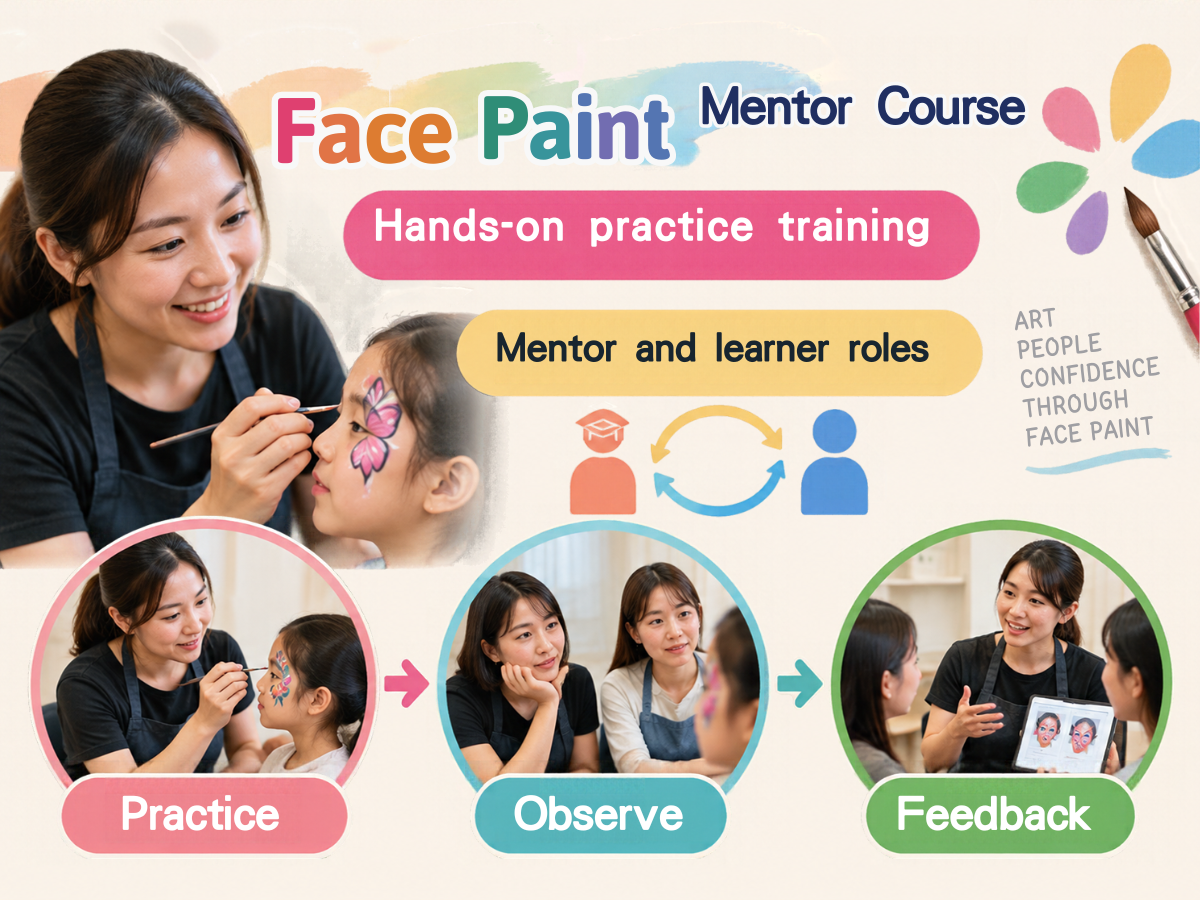
The course is divided into seven parts worth 15 credits in total. Read as a list of names, they mean little. Put them back into the kind of class you intend to run, and each one turns out to be handling a concrete problem.
Taken together, a structure appears: the first three parts handle the relationship between you and the learner, the middle three handle the room and the process, and the last handles you. That maps exactly onto the four gaps in Section 4 — they are closed by these seven parts, not by more technique.
7. Entry requirements: five years' experience, two years' training — how do you prove it?
Entry is assessed on two routes, and meeting either one is enough:
What counts as "training experience"
It is not only formal classes. The following normally count, subject to documentary verification: working as a course assistant or teaching assistant; delivering product training or demonstrations for a brand or retailer; running workshops in schools, NGOs or mall events; inducting juniors inside a television crew, production team or dance company; giving in-house technical coaching in a salon. The title matters less than whether the record can be verified — a stamped company letter, a class list, event photographs, a reference from a supervisor.
Documents to submit
Copy of Hong Kong identity card, copy of academic certificates, original proof of beauty-industry work experience (one of: stamped company letter, MPF contribution record, chamber or association certification), and the first instalment of tuition. Applicants using the qualification route also submit the certificate and transcript of the Level 3 qualification. Whether the file is complete often decides how many rounds of review are needed, so assemble the list before applying.
One point should be stated plainly: "accepted as equivalent" is not automatic. Bodies such as iTEC and IQA are international awarding organisations whose awards are valid internationally and within the trade, but they are not the same as an HKQF qualification entered on the local register. Whether a particular course accepts them as an entry qualification is decided by the institution on the evidence, and the counselling conversation should happen before enrolment rather than after.
8. Fees and CEF: how HK$15,000 becomes HK$3,500
For a self-employed painter, the decision to study usually hinges on cash flow rather than willingness. The fee structure of this certificate is relatively clear:
| Item | Amount | Note |
|---|---|---|
| Course fee | HK$15,000 | Three instalments of HK$5,000 |
| Placement fee | HK$5,000 | Counted against tuition, not an extra charge |
| CEF reimbursement (maximum) | HK$11,500 | Calculated on a first-ever CEF claim; attendance and assessment conditions apply |
| Net cost after reimbursement | As low as HK$3,500 | Roughly HK$1,167 per month |
| Assessment fee | Waived | Included in tuition |
| Practice tools | Included | Class tools supplied by the academy |
Four practical points about CEF are worth knowing in advance. First, reimbursement is paid after the course is completed and assessed, not deducted at enrolment, so the full fee and the cash flow must be covered first. Second, attendance and a pass are conditions of reimbursement; too many absences affect eligibility. Third, there is a lifetime cap on CEF for each person, so if you have claimed before, the amount actually reimbursed is calculated on the remaining balance. Fourth, the course must be on the CEF list, so confirm the course code and the current intake with the academy before applying.
Put another way: HK$3,500 is roughly the income from one mid-sized mall face-painting booking, or two to three bridal make-up jobs. Spending that to obtain a qualification usable for quoting, tendering and course promotion for years is a calculable investment for a working painter, not an expense.
9. What can you take afterwards, and what does "internationally recognised" actually mean?
On completion and passing the assessment, you receive the Certificate in Beauty Industry Teaching and Training (HKQF Level 3), worth 15 QF credits. Graduates may run their own classes and issue institutional certificates, and may also sit further international tutor awards at their own cost.
| Award you may sit at your own cost | Awarding body | Use for a face painting tutor |
|---|---|---|
| iTEC Education and Training Level 3 / 4 / 5 | iTEC (VTCT group), UK | An international tutor ladder; Levels 4 and 5 correspond to higher-level training and course-design responsibilities |
| IQA Level 3 / 4 / 5 Certificate in Education and Training | International Qualifications Alliance, Hong Kong | A local-and-international tutor qualification that supports running classes and institutional partnerships in Hong Kong |
| Certificate in Education and Training | IFBC / GPF, Korea | Useful for the Korean market or for co-running courses with Korean institutions |
How to read "internationally recognised"
The phrase needs care, because two common misreadings follow it.
First, the Hong Kong Qualifications Framework has completed level comparisons with the European Qualifications Framework (EQF), the UK, Ireland, Scotland and New Zealand, and is pursuing cooperation with Australia, Korea, Singapore and Guangdong. Under the official comparison, HKQF Level 3 corresponds to EQF Level 4, and sits at the same level as a UK RQF Level 3 vocational qualification. This is the basis of the international reference.
Second, a level comparison does not automatically confer a licence to practise in another country. It means your qualification has a defined position within an international reference framework, so employers, colleges and institutions can understand your level. If you wish to teach or practise in a particular country, you still apply or assessment under local requirements. Keeping the two ideas apart avoids both over-promising and undervaluing the award.
For a face painting tutor, the certificate's practical effect shows up in three settings: qualification checks when an institution procures training services; evidence of tutor qualification when bidding for government, school or mall programmes; and level-comparison statements when co-running courses with overseas partners.
10. The benefits: five government frameworks and six usable scenarios
The same question comes up repeatedly: what is this certificate actually for? The answer has two layers. The first is whether there is a position that can be checked; the second is how many systems recognise that position. The first is about credibility, the second about portability.
Start with the government layer: it is not a trade-made standard
The Hong Kong Qualifications Framework is not an industry standard drawn up by a chamber or a union. It was established by the Hong Kong Special Administrative Region Government under the Academic and Vocational Qualifications Ordinance (Cap. 592), fully implemented on 5 May 2008, with seven levels. A course must be recognised by the Hong Kong Council for Accreditation of Academic and Vocational Qualifications under that Ordinance before it can be entered on the Qualifications Register with a level and credit value. The code and level printed on the certificate therefore rest on a statutory mechanism, not on a printer.
Beyond that mechanism, the HKQF has completed level comparisons with a number of overseas frameworks. The five systems below are the ones most often cited by tutors in CVs, course outlines and overseas partnership documents:
| System / government | Framework | Relationship with HKQF | Practical meaning for a tutor |
|---|---|---|---|
| Hong Kong SAR | HKQF (seven levels, Cap. 592) | The local statutory framework; this certificate is on the register as 26/000912/L3 | Employers, schools and institutions can verify immediately, without relying on referral or reputation |
| Europe | European Qualifications Framework (EQF, eight levels) | Level comparison completed; HKQF Level 3 = EQF Level 4 | CVs can state the European reference level, which multinational employers and European colleges read instantly |
| Ireland | Irish National Framework of Qualifications | Level comparison completed | A shared level language when co-running courses with Irish colleges or institutions |
| Scotland | Scottish Credit and Qualifications Framework (SCQF) | Level comparison completed | Useful when applying for Scottish programmes or institutional roles |
| New Zealand | New Zealand Qualifications Framework (NZQF) | Level comparison completed | A reference point for Oceania partnerships and credential evaluation |
(Apart from the EQF comparison, specific mapped levels should be taken from the official comparison tables published by the respective authorities; this article does not list them one by one, to avoid misquotation.)
What does "level comparison completed" mean? It does not mean a Hong Kong certificate automatically becomes a European or New Zealand certificate. It means the two frameworks have a mutually confirmed conversion relationship. Take the analogy of two thermometers, one marked in Celsius and one in Fahrenheit: the scales differ, but they measure the same temperature, and a conversion lets them talk. The practical use for a tutor is concrete — when you submit a qualification to an overseas institution, an immigration authority or a multinational employer, the reader does not need to understand the Hong Kong system; a level comparison tells them roughly where you stand.
Six benefits, each tied to a real setting
Putting the benefits back into a face painter's situation
Three situations recur for painters, and they map onto the benefits above. First, a mall or corporate family-day booking: the procurement team asks for tutor qualification and insurance, and the register number can go straight onto the quotation. Second, school outreach and extracurricular programmes: procurement usually requires a verifiable tutor qualification and a statement of how the activity links to learning objectives. Third, collaborations with pigment, toy or mother-and-baby brands: brands tend to choose tutors whose qualifications can be quoted publicly, because the marketing material has to say something.
Taken together, the certificate's value is not that you paint better. It solves a different set of problems: it can be verified, it can be converted, and it can be procured. Those three are exactly what freelancers most often lack.
11. From competency units to your first class: a usable design process
After the certificate, the real test is designing the first class. The process below is the practical version, aligned to the course content and the SCS, and applies to any training built around body painting.
A worked example: a three-hour session on "simple animal faces". Hour one covers face anatomy, symmetry and which pigments are appropriate for children. Hour two demonstrates the layering of base, mid-tone and highlight on a curved cheek, with the class practising on each other's forearms. Hour three has pairs complete a specified brief (a tiger for a six-year-old's birthday party) and peer-assess with the rubric.
That structure looks simple, but it solves four things at once: a clear endpoint in hour three, a focused demonstration in hour two, assessment with criteria through the rubric, and safety addressed in hour one. This is what the seven parts in Section 6 look like in practice.
12. Five common misconceptions
13. Frequently asked questions
Sources
1. Beauty Industry Specification of Competency Standards, including the body-painting units BEZZMU209A, BEZZMU307A, BEZZMU308A, BEZZMU311A and BEZZMU501A, Qualifications Framework Secretariat.
2. LBEDU course page: Certificate in Beauty Industry Teaching and Training (HKQF Level 3), course code CTPT3, Qualifications Register 26/000912/L3.
3. LBEDU: Hong Kong Qualifications Framework — a comprehensive guide to levels, recognition and international comparisons (updated 23 June 2026), covering HKQF comparisons with EQF, the UK, Ireland, Scotland and New Zealand.
4. Academic and Vocational Qualifications Ordinance (Cap. 592), Hong Kong SAR.
Comments (0)
No comments yet
Leave a Comment