
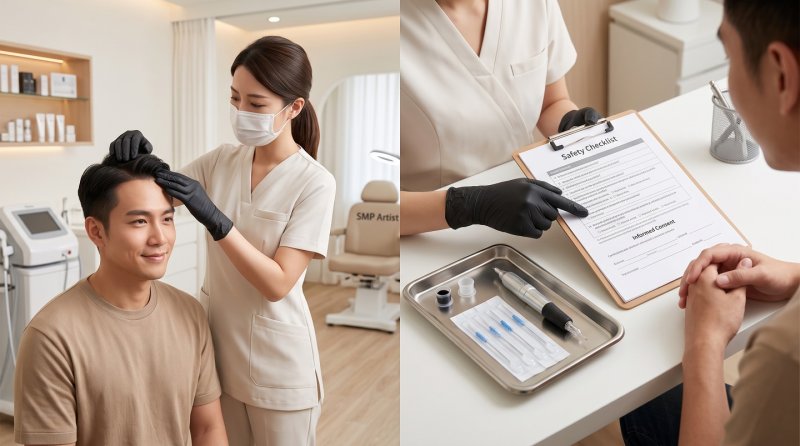
- ‧TVB Scoop reported an SMP hair tattoo case; LBEDU and IQA offer professional reflection from an industry harmony perspective, grateful to TVB and the individual for this valuable learning case
- ‧The SMP industry as a whole is professional and trustworthy; this is an isolated case and consumers should not label the entire industry
- ‧SMP is a semi-permanent beauty technique using pigment to create the visual effect of denser hair; it is not a medical treatment and cannot regrow hair
- ‧5 pre-treatment safety checks: medical history inquiry, patch test, product ingredient explanation, informed consent, contraindication screening
- ‧Practitioners and clients are partners, not adversaries — mutual understanding and respect lead to the best treatment outcomes
- ‧This case offers the entire industry ten learning and reflection points, including safety standards, transparent communication, and complaint handling for continuous improvement
- ‧We hope the individual and the beauty centre can resolve the issue promptly for the health and wellbeing of both parties, and that the industry continues to develop professionally
- This article is co-authored by LBEDU Luster Beauty International Education & Training Academy and the IQA International Qualification Assessment Alliance, offering industry reflection on the SMP scalp micropigmentation case reported by TVB Scoop. The article emphasises that the SMP industry as a whole is professional and trustworthy, and that isolated cases should not label the entire industry. Content covers an introduction to SMP technology, ten industry learning and reflection points, five pre-treatment safety checks, practical advice for both clients and practitioners, and well wishes for the individual and the beauty centre. The core message is industry harmony, continuous improvement, mutual respect, and building trust together — hoping that through public education, the public will better understand the SMP industry and rebuild confidence in the beauty sector.
SMP Scalp Micropigmentation Safety Reflection | TVB Scoop Case Insights for the Industry
Source: TVB Scoop (東張西望)
We are grateful to TVB and the individual for providing our industry with this valuable case for reflection.
This article is an industry educational reflection based on publicly reported news. Its purpose is to promote industry professional development and consumer education. It does not target any specific organisation or individual.
Key Highlights
- Case Background: TVB Scoop reported a young person with crown hair loss who underwent SMP hair tattoo treatment with no improvement, sparking public attention
- Industry Position: The SMP industry as a whole is professional and responsible; this is an isolated case and consumers should not label the entire industry
- Reflection Value: This case offers the entire industry a valuable opportunity to reflect on how to improve safety standards
- 5 Safety Checks: ① Medical History Review ② Patch Test ③ Product Ingredient Explanation ④ Informed Consent ⑤ Contraindication Screening
- Harmony & Win-Win: Practitioners and clients are not adversaries but partners — mutual understanding and respect lead to the best outcomes
- Best Wishes: We hope the individual and the relevant beauty centre can resolve the issue promptly for the health and wellbeing of both parties
1. Case Review: TVB Scoop Report Offers Industry Reflection
Recently, TVB Scoop reported a case involving SMP scalp micropigmentation (commonly known as hair tattoo). A young person experiencing crown hair loss sought beauty treatment assistance and paid for a "hair regeneration tattoo" service. After the treatment, the condition did not improve as expected, and a dispute arose between both parties regarding refunds and follow-up handling. The centre requested the signing of a non-disclosure agreement (NDA) before processing the refund. Following media coverage, the event sparked widespread public concern about beauty treatment safety and consumer rights.
At LBEDU and the IQA International Qualification Assessment Alliance, we are grateful to TVB and the individual for providing our industry with this valuable case for reflection. This case is not about blaming anyone — it is about reminding the entire industry that safety standards, professional ethics, and consumer communication are all areas worthy of continuous review and improvement.
| Stage | Event | Industry Reflection Point |
|---|---|---|
| Pre-Treatment | Young person seeks help for crown hair loss, discovers SMP hair tattoo service | Hair loss has diverse causes; pre-treatment consultation and assessment are crucial |
| During Treatment | Pays fee, undergoes "hair regeneration tattoo" treatment | Treatment nature, expected results, and product information need clear communication |
| Post-Treatment | Condition does not improve as expected; dispute arises between parties | Post-treatment follow-up and outcome assessment mechanisms need improvement |
| Complaint Stage | Centre requests NDA signing before processing refund | Complaint handling mechanisms and consumer communication methods warrant industry reflection |
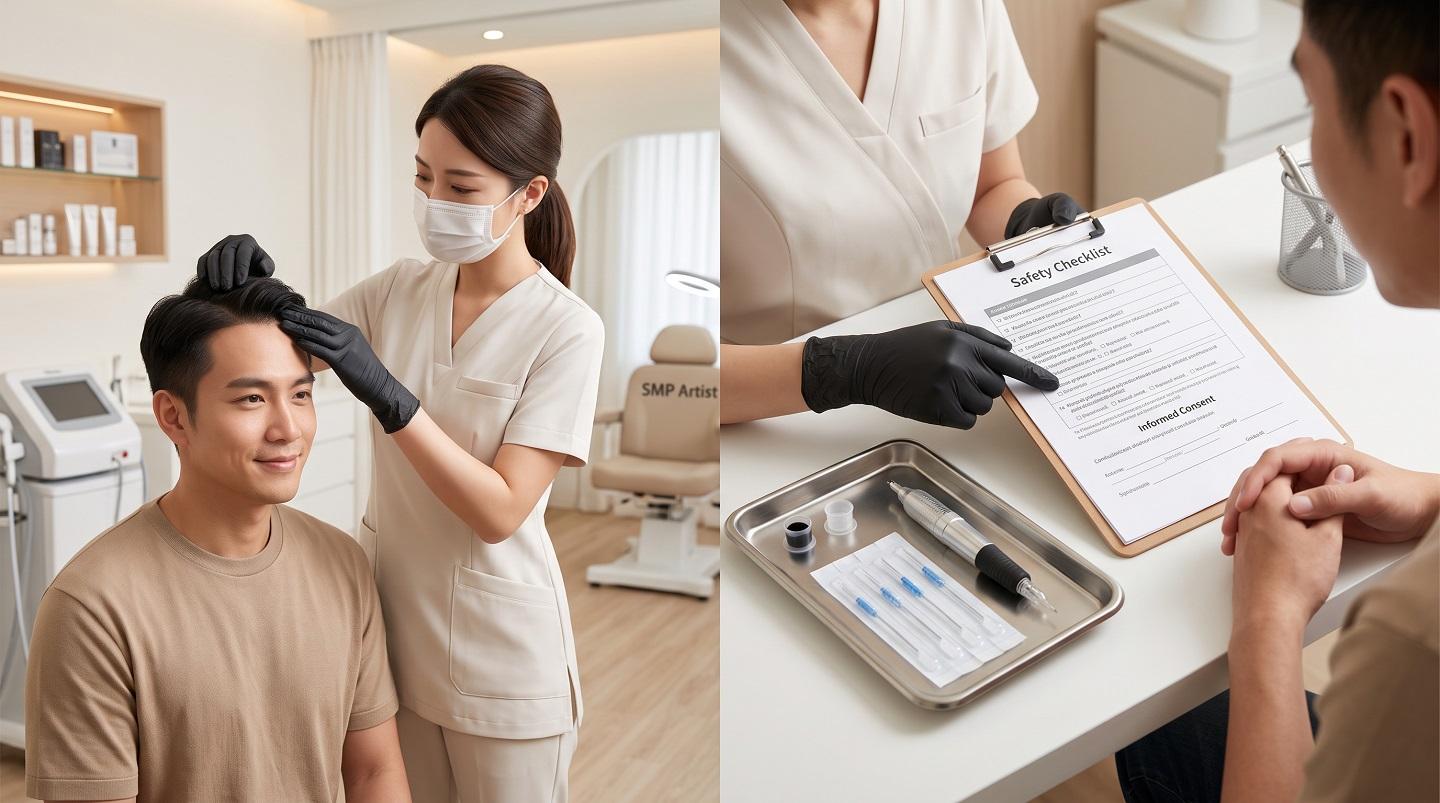
2. Industry Harmony: The SMP Industry as a Whole is Professional and Trustworthy
First and foremost, we must emphasise: this is an isolated case and does not represent the entire SMP or beauty industry.
Hong Kong's SMP and semi-permanent makeup industry is home to many professional, responsible practitioners and establishments. They serve clients with dedication every day, strictly adhere to safety standards, continuously upgrade their skills through further education, and bring confidence and beauty to many people in need. SMP technology has helped countless individuals with hair loss rebuild their confidence — this is the value and contribution of our industry.
We wrote this article not to label or criticise fellow practitioners, but to use this case as a mirror for the entire industry to reflect together: Where else can we do better? How can we make clients feel more at ease and reassured? How can we make our industry more professional and trustworthy?
LBEDU x IQA Industry Harmony Position
- The SMP industry as a whole is professional and responsible; isolated cases should not label the entire industry
- Practitioners and clients are not adversaries but partners — mutual understanding and respect
- This case is a valuable reflection opportunity to help the entire industry continuously raise professional standards
- We hope through public education, the public will better understand the SMP industry and rebuild confidence in it
- We wish the individual and the relevant beauty centre a prompt and satisfactory resolution for the health and wellbeing of both
3. Understanding SMP: A Professional Beauty Technique
To understand this case, we first need to understand what SMP actually is. SMP (Scalp Micropigmentation, commonly known as hair tattoo or scalp tattooing) is a professional semi-permanent beauty technique that uses fine needles to implant safe pigment into the scalp epidermis, creating the visual effect of denser hair.
- Professional Technique: Requires expertise in scalp anatomy, needle selection, insertion angle, depth control, and pigment formulation
- Visual Effect: SMP uses pigment to create the visual appearance of denser hair, helping people with hair loss improve their appearance and rebuild confidence
- Safety Standards: Because it involves invasive procedures, strict adherence to sterile protocols, patch testing, and contraindication screening is essential
- Maintenance Required: Pigment gradually fades with metabolism; regular touch-ups are typically needed to maintain optimal results
SMP technology can help many people in need:
- Individuals with androgenetic alopecia (male/female pattern baldness), improving the appearance of thinning hair
- Those with uneven hair distribution following alopecia areata recovery
- People with scarring hair loss (e.g. from burns or trauma), covering scarred areas
- Those wishing to shape their hairline or improve thinning at the parting line
- Post-chemotherapy recovery individuals seeking appearance improvement (requires medical assessment)
SMP is a valuable beauty technique that helps many people rebuild confidence. Of course, any invasive beauty treatment requires attention to safety — and this is precisely the important reflection this case brings us.
4. Industry Reflection: Ten Learning Points This Case Brings Us
Below are ten learning and reflection points that LBEDU and IQA have distilled from this case. These are not criticisms but directions in which our entire industry can improve together. Every practitioner can use them for self-assessment and continuous growth.
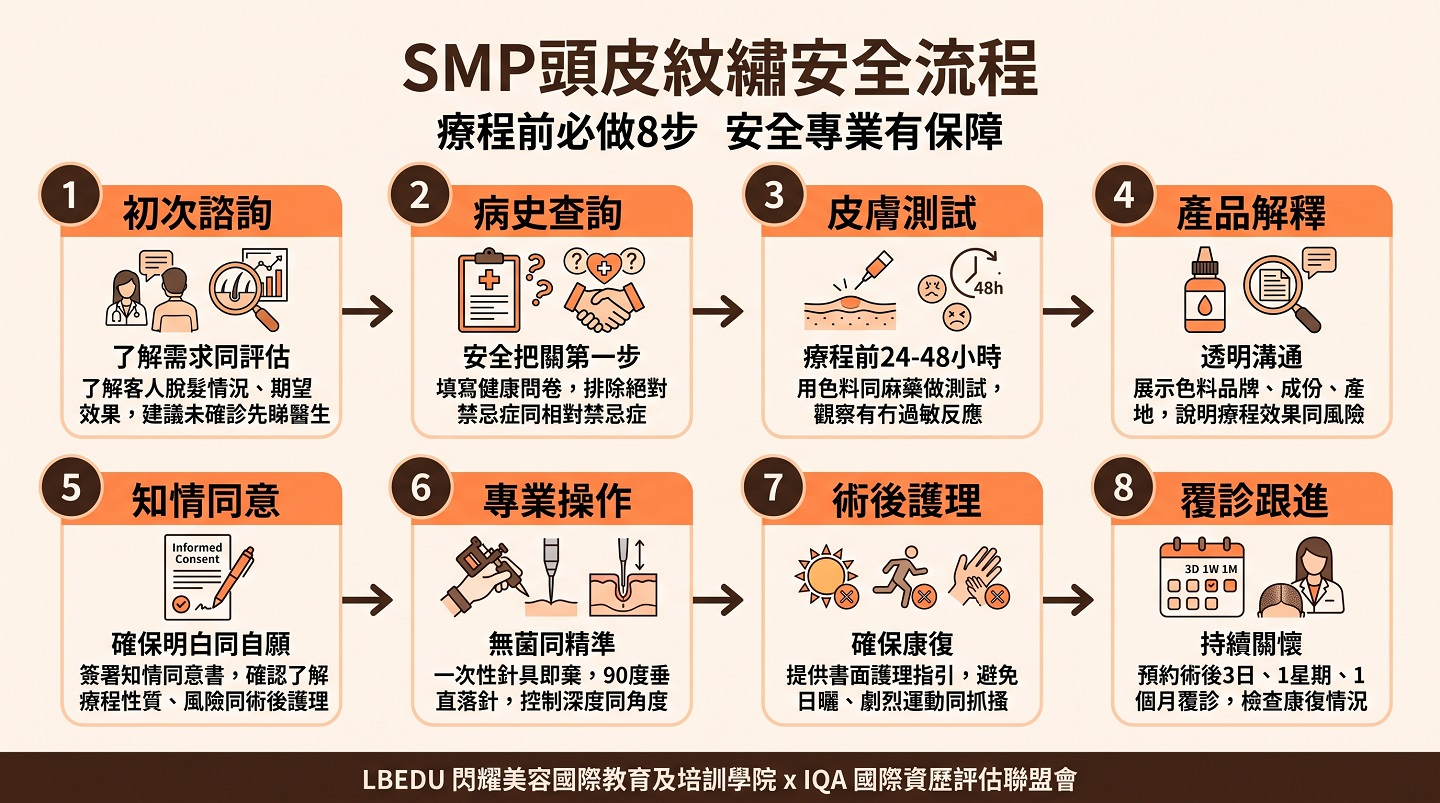
5. 5 Pre-Treatment Safety Checks (A Reference for Both Practitioners and Clients)
The following 5 safety checks are fundamental steps that should be confirmed before any SMP or semi-permanent makeup treatment. This checklist can serve as a self-assessment tool for practitioners and as a reference for clients to understand the treatment process. When both practitioners and clients prioritise safety together, the best treatment experience is achieved.
5 Pre-Treatment Safety Checklist
- Medical History Review: Understand the client's health condition, including chronic diseases, allergy history, scarring tendencies, pregnancy/breastfeeding status, etc., to ensure the client is suitable for treatment
- Patch Test: Perform a patch test with the pigment and anaesthetic to be used 24–48 hours before treatment, observing for allergic reactions
- Product Explanation: Show and explain the product brand, ingredients, and origin to the client, clearly communicating treatment results and potential risks
- Informed Consent: Sign an informed consent form, confirming the client understands the treatment nature, risks, and aftercare, and voluntarily consents
- Contraindication Screening: If the client has any health concerns or unsuitable conditions, advise medical consultation first — safety always comes first
These 5 checks are not an extra burden but a fundamental safeguard protecting both clients and practitioners. When practitioners take them seriously and clients undergo them with peace of mind, everyone benefits.
6. Advice for Clients: How to Undergo SMP Treatment with Peace of Mind
As a client, learning more about the SMP industry can help you undergo treatment with greater confidence. Here are some practical suggestions:
SMP uses pigment to create the visual effect of denser hair. It is a semi-permanent beauty service, not a medical treatment, and it does not regrow hair. Understanding the nature and expected results of SMP clearly can help you set reasonable expectations.
Don't be afraid to ask questions! You have the right to know: What brand of pigment is being used? Is a patch test performed? What does the treatment process involve? How should I care for the area afterwards? How long will the results last? A professional practitioner will be happy to answer your questions.
Before undergoing treatment, you can observe: Is a patch test performed? Does the practitioner ask about your health condition? Are needles single-use and disposable? Does the operator wear gloves? Is the environment clean? These are all basic safety standards.
Follow the aftercare instructions and attend scheduled follow-up appointments. If you experience any discomfort or abnormalities, contact your practitioner promptly. Good post-treatment care is an important guarantee of both results and safety.
If you have any concerns about your treatment, first communicate with your practitioner or the centre, expressing your concerns and expectations. Most issues can be resolved through communication. If communication fails, you can seek assistance from organisations such as the Consumer Council for mediation.
7. Advice for Practitioners: Continuously Raising Professional Standards
As members of the SMP industry, each of us has a responsibility to maintain the professional image and reputation of our industry. Here are some directions for continuous improvement:
Patch testing, medical history review, sterile procedures, informed consent — these basic safety standards must not be skipped because of inconvenience or time pressure. Safety is the industry's baseline and a protection for both clients and ourselves.
Beauty techniques and safety standards are constantly evolving. Practitioners should pursue ongoing education to keep up with the latest techniques and regulations. Attending training courses, industry seminars, and obtaining professional certifications are all excellent ways to improve yourself.
Many misunderstandings and disputes arise from insufficient communication. Clearly explaining results and risks before treatment, attending to the client's feelings during treatment, and proactively following up afterwards — good communication builds trust and reduces problems.
When faced with client dissatisfaction, don't avoid or deflect. Listen, understand, resolve — face complaints positively and actively seek solutions. A single well-handled complaint can earn a client's long-term trust.
Practitioners are not competitors but fellow professionals. Learning from each other, respecting one another, and collectively raising industry standards creates a win-win situation. LBEDU and IQA are willing to exchange and cooperate with all industry establishments to jointly promote the professional development of our industry.
8. Best Wishes: Hoping the Individual and Beauty Centre Resolve the Issue Promptly
Wishes for the Individual: We hope your hair loss concern receives appropriate assistance and improvement, and that you enjoy good health and a positive mindset. Although this experience was unpleasant, your courage and sharing have helped the entire industry reflect and progress. Many people will receive safer services because of your experience. Thank you.
Wishes for the Relevant Beauty Centre: We hope you can reach a mutually satisfactory resolution with the individual as soon as possible. This case is also a valuable learning opportunity — after review and improvement, you will undoubtedly be able to provide more professional and safer services to your clients.
Wishes for the Entire Industry: We hope the SMP and beauty industry continues to develop professionally, bringing confidence and beauty to more people in need. May practitioners and clients understand and respect each other, building a harmonious and inclusive industry environment together.
Wishes for Everyone Following This Case: Thank you for your care and attention. We hope that through this case, everyone gains a better understanding and awareness of the SMP industry. The beauty industry is home to many dedicated professionals — please do not label the entire industry because of isolated incidents.
9. Frequently Asked Questions (FAQ)
10. Conclusion: Industry Harmony, Continuous Improvement, Rebuilding Trust
The SMP case reported by TVB Scoop brings our industry a valuable opportunity for reflection. At LBEDU and the IQA International Qualification Assessment Alliance, we are grateful to TVB and the individual for providing us with this case for learning and reflection.
This case reminds us that SMP is a professional beauty technique that helps many people rebuild confidence. At the same time, because it involves invasive procedures, attention must be paid to safety standards and professional ethics. Patch testing, medical history review, product explanation, informed consent, contraindication screening, sterile procedures, and post-treatment follow-up — every step is a fundamental standard that professional practitioners should uphold.
At the same time, we must emphasise that this is an isolated case and does not represent the entire SMP or beauty industry. Hong Kong is home to many professional, responsible SMP practitioners and establishments who serve clients with dedication every day, bringing confidence and beauty to many people in need. Consumers should not label the entire industry because of isolated incidents.
Practitioners and clients are not adversaries but partners. When practitioners continuously raise their professional standards and clients take the time to understand and communicate with the industry, mutual respect and trust lead to the best treatment experience and outcomes.
Finally, we sincerely wish: that the individual and the relevant beauty centre can resolve the issue promptly for the health and wellbeing of both parties. That the SMP industry continues to develop professionally, bringing confidence and beauty to more people. That through this case, the public gains a better understanding and awareness of the beauty industry and rebuilds confidence in it.
Industry Harmony, Continuous Improvement, Mutual Respect, Building Trust Together — LBEDU x IQA Walking With You
Further Reading
1. Complete Guide to Semi-Permanent Makeup Pigment Safety | Pigment Classification, Key Ingredients, Why Results Turn Red or Grey
2. Semi-Permanent Makeup Safety Guidelines | Absolute and Relative Contraindications, Infection Control Risks
3. Complete Guide to SMP Scalp Micropigmentation Technique | Needle Selection, Insertion Angle, Line Techniques
4. Beauty Industry Professional Ethics | Safety Standards and Ethical Guidelines Practitioners Should Follow
5. How Consumers Can Choose Safe Beauty Services | 10 Essential Questions to Ask Before Treatment
About LBEDU and IQA
Founded in 2013, LBEDU is a Hong Kong Government-Registered Academy (Registration No. 854) specialising in beauty education and international professional qualifications training. The academy holds comprehensive international accreditation, including consecutive QF Star-rated Training Institution awards, CEF Continuing Education Fund recognition, VTCT/ITEC UK Official Authorised Assessment Centre status, and JECA Japan Eyelash Certification School designation. LBEDU is committed to promoting safety standards and professional education in the beauty industry.
The IQA International Qualification Assessment Alliance is an industry organisation dedicated to promoting the professionalisation and standardisation of the beauty industry. It strives to establish industry qualification assessment standards, promote safety protocols and professional ethics, organise industry training and seminars, and foster exchange and harmony among practitioners. The IQA Annual Outstanding Academy Awards, known in the industry as the "Beauty Industry Nobel Prize," recognises academies that excel in teaching quality and industry contribution.
Academy Address: Shop C, G/F, Wing Sing Building, 21-35 Castle Peak Road, Kowloon, Hong Kong
Enquiry Hotline: (852) 9548 8600
WhatsApp: https://wa.me/85295488600
Official Website: lbacademy.com.hk
Comments (0)
No comments yet
Leave a Comment