
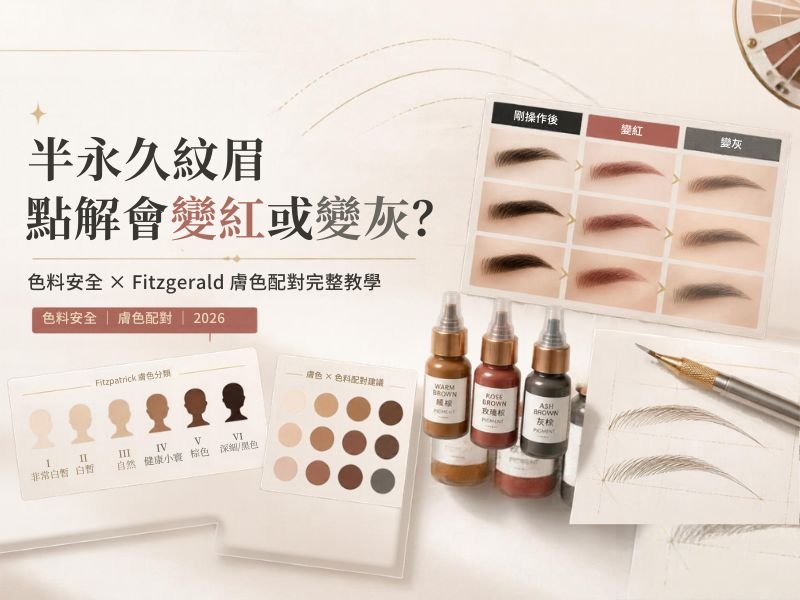
- ・Semi-Permanent Makeup (SPM) principle: pigment particles are implanted via specialized needles between the basal epidermis and upper dermis (approximately 0.15-0.25mm depth), where skin cell metabolism is slower, allowing pigment to last 1-3 years before gradually being eliminated through stratum corneum renewal and macrophage phagocytosis; pigment is not a single color but a mixture of multiple mineral and organic pigments, with different color particles varying in size, metabolic rate, and stability — when black metabolizes faster than red, red emerges; when black oxidizes, gray-blue appears.
- ・Four main pigment ingredient categories: Iron Oxide (Inorganic Iron Oxide, black/brown/red/yellow, larger particles less diffusion, high stability slow metabolism, primary base of professional-grade pigments); Titanium Dioxide (white for lightening, extremely fine particles strong coverage, stable but excessive causes whitening); Organic Pigments (red/yellow/orange, fine particles vivid colors, faster metabolism easy fading, heavy use in cheap pigments causes late-stage redness); Carbon Black (deep black, extremely fine particles easy diffusion, long-term may oxidize to blue); EU REACH regulations prohibit pigments containing heavy metals (lead, mercury, cadmium).
- ・Three causes of eyebrow tattoo redness: Cause 1 red pigment residue (most common) — cheap pigments use large amounts of organic red pigment to create "natural brown", looking good initially but red base emerges after black oxidizes/metabolizes; Cause 2 skin tone mismatch — Fitzpatrick I-IV light-skinned individuals using warm (reddish/yellowish) pigments, light skin has less melanin in lower layers making red more visible, plus Asian skin has yellow undertone, warm tones mix to orange-red; correct approach is cool tones (ash brown, dark brown, charcoal) for light skin; Cause 3 improper post-care causing Post-Inflammatory Hyperpigmentation (PIH) — scab picking, sun exposure during healing, irritating skincare (AHA/retinol/whitening), swimming/prolonged water contact.
- ・Three causes of eyebrow tattoo gray/blue discoloration: Cause 1 excessive needle depth pushing pigment into deep dermis — SPM should be implanted between basal epidermis and papillary dermis (0.15-0.25mm), excessive force pushes into deep dermis, pigment 长期 contacts blood iron ions causing oxidation, carbon black pigment scatters light showing blue tone (Tyndall effect); Cause 2 pigment particles too coarse to be metabolized — quality pigments have nano-ground uniformly sized particles (1-5 microns) phagocytosed by macrophages, cheap pigment particles over 10 microns cannot be cleared by immune cells, permanently retained in deep layers and oxidizing over time; Cause 3 dark-skinned individuals using wrong cool tones — Fitzpatrick V-VI dark skin using cool (gray-black) pigments easy gray/blue later, should use warm tones (reddish brown, chocolate brown, dark brown).
- ・Fitzpatrick Skin Type Classification, proposed by Harvard dermatologists in 1975, is now the global gold standard for skin tone assessment in aesthetic medicine, with six types: Type I very fair skin freckles common (always burns never tans, recommended cool tone Light Ash Brown); Type II fair skin light eyes (burns easily tans minimally, cool tone Ash Brown Soft Brown); Type III medium skin common in East Asia (burns sometimes tans gradually, cool tone primary Natural Brown Dark Brown); Type IV wheat/light brown skin (rarely burns tans easily, neutral-cool Chocolate Brown Espresso); Type V brown skin (rarely burns tans very easily, warm tone Dark Brown Reddish Brown); Type VI dark brown/black skin (never burns very deep pigment, warm tone Black Brown Deep Ebony).
- ・Core color matching principle: Fitzpatrick I-IV use cool-tone pigments (ash brown, dark brown, charcoal), Fitzpatrick V-VI use warm-tone pigments (reddish brown, chocolate brown, dark brown); most Hong Kong people are Type III (medium skin), should primarily use cool-tone dark brown, avoiding reddish/orange warm pigments; consumer five-step self-check: Step 1 inquire pigment brand and ingredients (whether compliant with EU REACH or US FDA standards, e.g. Perma Blend, Biotouch); Step 2 request Fitzpatrick skin type assessment; Step 3 view real cases especially late-stage results (3-6 month follow-up photos); Step 4 confirm aseptic operation and disinfection standards (disposable needles, autoclave instrument handles); Step 5 follow post-care instructions (no scab picking, avoid sun/swimming/irritating skincare during healing).
- ・Three color correction methods: Method 1 Color Correction for mild discoloration — redness neutralized with green corrector, blueness neutralized with orange corrector, grayness covered with warm brown; Method 2 Laser tattoo removal for moderate to severe discoloration — Q-switched Nd:YAG laser shatters deep pigment, usually 3-6 sessions, must be performed by registered doctor; Method 3 Camouflage tattoo — if discoloration not too deep, can directly cover with darker pigment; important reminder: if severe redness, pain, pus after eyebrow tattoo, possible bacterial infection (including MRSA methicillin-resistant Staphylococcus aureus), seek medical attention immediately do not self-treat.
Written by LBEDU Principal Joanne Wong, this consumer science article explains why semi-permanent eyebrows turn red or gray-blue. SPM implants pigment at 0.15-0.25mm (epidermis-dermis junction), lasting 1-3 years. Four pigment types: iron oxide (stable), titanium dioxide (lightener), organic pigments (fast metabolism, causes redness), carbon black (oxidizes blue). EU REACH bans heavy metals. Three redness causes: organic red residue, skin tone mismatch (light skin warm tones), post-care PIH. Three gray/blue causes: excessive depth (Tyndall effect), coarse particles (>10μm), dark skin wrong cool tones. Fitzpatrick 1975 Harvard gold standard: I-IV cool tones, V-VI warm; Hong Kong mostly Type III → cool dark brown. Five-step consumer check. Correction: color correction, Q-switched Nd:YAG laser (3-6 sessions, doctor), camouflage. MRSA infection warning. Graduate Melody CHEN case: cheap salon brows turned orange-red, then learned proper color theory at LBEDU. Principal warns: 3-day crash courses don't teach skin structure, professional comes from solid training.
Comments (0)
No comments yet
Leave a Comment