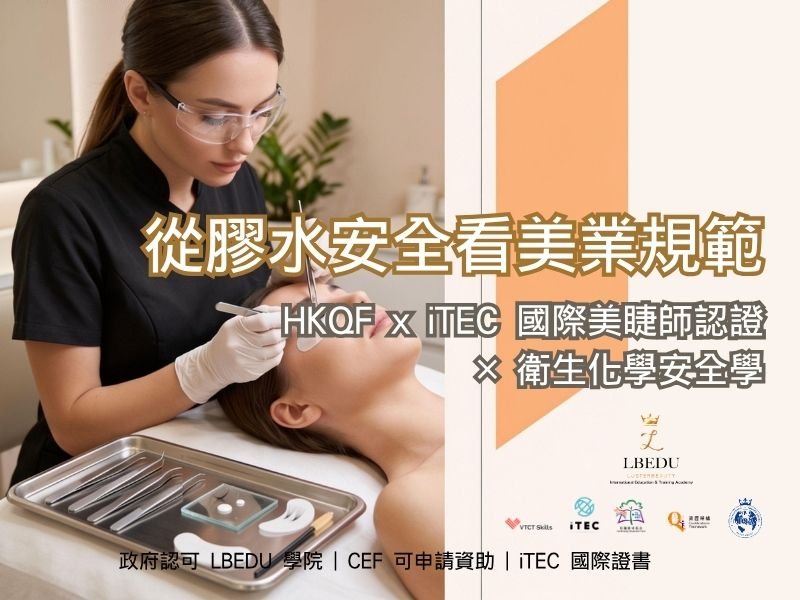
- ‧ Recent consumer council tests found formaldehyde and hydroquinone in some eyelash glues, sparking cancer risk concerns.
- ‧ Low-quality glues use industrial-grade ingredients releasing formaldehyde – long-term exposure harms lash technicians' health.
- ‧ Hydroquinone is banned in many countries due to cytotoxicity – causes severe skin damage and allergies.
- ‧ Fast-track courses focus only on application techniques, ignoring chemistry, anatomy, and hygiene – iTEC prioritizes Health & Safety.
- ‧ iTEC mandates standard Patch Test SOP to identify allergies and contraindications – essential for legal risk protection.
- ‧ LBEDU (Government Registered School 854) offers iTEC courses with CEF funding up to 80%-85% for eligible learners.
- ‧ iTEC Level 3 certification demonstrates international safety standards – enhances customer trust and pricing power.
- Recent consumer council tests found formaldehyde and hydroquinone in eyelash glues, sparking cancer risk concerns. Low-quality glues release formaldehyde during curing – hazardous for lash technicians. Hydroquinone is banned due to cytotoxicity. Fast-track courses neglect chemical safety, anatomy, and hygiene – iTEC prioritizes Health & Safety with mandatory Patch Test SOPs. LBEDU offers iTEC courses with CEF funding up to 85%. iTEC Level 3 certification demonstrates international safety standards – enhancing trust and pricing power.
Eyelash Glue Safety: Why International Eyelash Certification Is the First Step to Safe Practice
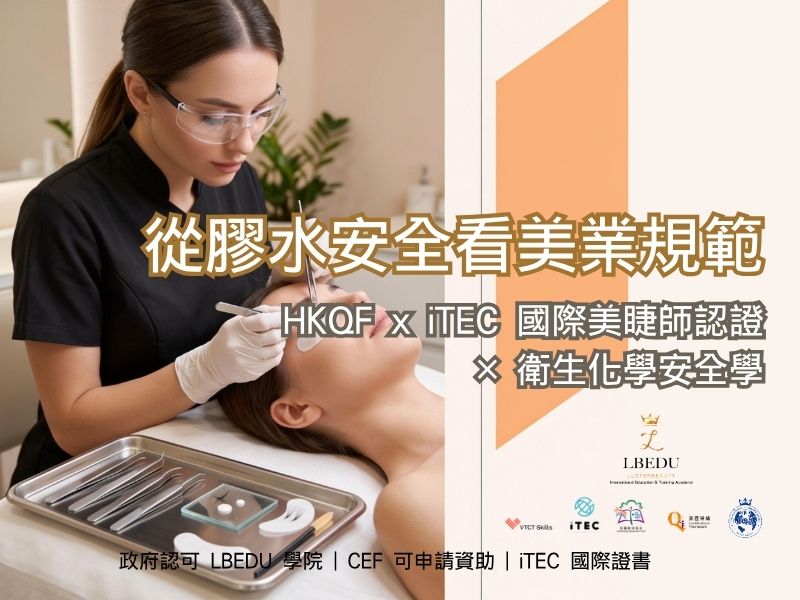
Recent test results released by the Consumer Council and the Shanghai Consumer Protection Commission on multiple eyelash extension glues have shocked consumers and sparked widespread discussion. The tests revealed that some samples contained high levels of "free formaldehyde" – a substance known to be highly irritating and potentially carcinogenic – as well as the banned ingredient "hydroquinone." Some product ingredients were even found to be similar to industrial "super glue." Suddenly, the question "Can eyelash extensions cause cancer?" became a trending topic.
However, as professional beauty practitioners or students preparing to enter the industry, we must recognise a critical truth: While the market is flooded with products of varying quality, the real core issue is whether the eyelash technician possesses the professional ability to identify product safety, follow standardised procedures, and manage risks.
"Eyelash extensions" are far more than just a technical skill of attaching fake lashes to natural ones – it is a rigorous discipline encompassing ocular anatomy, product chemistry, salon-grade hygiene and disinfection, and client allergy risk management. This article starts from this news event to explain why obtaining iTEC international eyelash certification is essential for protecting both clients and lash artists, and how LBEDU's CEF (Continuing Education Fund) courses uphold international safety standards.
1. The Chemical Truth Behind the News: Why Can Eyelash Glue Be Toxic?
Working in the highly sensitive area around the eyes means that even minor chemical irritation can cause acute conjunctivitis, corneal burns, or severe allergic reactions. Poor‑quality eyelash glues primarily pose two hidden dangers:
The main ingredient in eyelash extension glue is "cyanoacrylate." Low‑quality products use industrial‑grade raw materials of extremely low purity to cut costs, or add unstable preservative formulas, causing the glue to continuously release free formaldehyde during the curing process and storage. Long‑term inhalation or exposure not only causes eye irritation for clients, but the people most affected are often the lash technicians who work in close proximity for extended periods every day.
Hydroquinone is listed as a prohibited or strictly restricted ingredient in cosmetic regulations across many countries. Some unscrupulous manufacturers illegally add it as an antioxidant or preservative to extend shelf life. This ingredient is cytotoxic and can easily cause skin cell damage and severe allergic reactions.
2. Understanding Product Safety Labels: MSDS, SGS, ISO & GMP Explained
As a professional eyelash technician, mastering application techniques is only half the story – you also need the ability to interpret product safety documentation. The following four certifications are the core indicators for determining whether an eyelash glue or related product is safe and compliant:
An MSDS is a chemical safety document provided by the product manufacturer, detailing ingredients, hazard identification, first‑aid measures, storage conditions, and disposal methods. Professional lash technicians should proactively request and read the MSDS before using any glue, confirming that the product contains no banned ingredients and that free formaldehyde levels comply with international standards. This document is not only a product safety ID card but also a crucial legal reference in case of consumer disputes.
SGS is a world‑leading inspection, verification, testing, and certification company, and its test reports carry high credibility. Eyelash products that have passed SGS testing have been verified for heavy metal content, microbiological contamination, formaldehyde release, and other safety indicators. Consumers and lash technicians should prioritise products that come with SGS test reports and avoid using unverified or questionable products.
The most relevant ISO standard for eyelash products is ISO 22716 – Cosmetics Good Manufacturing Practices (GMP). This certification ensures that products are manufactured under strict quality management and hygiene standards. Manufacturers with ISO certification operate in environments where production, raw material control, and process stability meet international requirements, significantly reducing the risk of contamination or quality inconsistency.
GMP certification is a basic quality threshold for the cosmetics and medical device industries. A factory with GMP certification demonstrates that its production environment, personnel hygiene, equipment cleaning, and quality control all follow standardised operating procedures, ensuring batch‑to‑batch consistency and safety. When purchasing eyelash glue, consumers should prioritise products bearing GMP certification numbers and avoid products with unclear ingredient labelling or unknown origins.
| Certification | Full Name | Core Function | Importance for Eyelash Products |
|---|---|---|---|
| MSDS | Material Safety Data Sheet | Discloses ingredients, hazard identification, first‑aid measures, and storage guidelines | Must be reviewed before using any product – confirms absence of banned or high‑risk ingredients |
| SGS | Société Générale de Surveillance | Third‑party testing for heavy metals, microbiology, formaldehyde release, and other safety indicators | Products with SGS reports have been verified by an internationally trusted organisation |
| ISO 22716 | Cosmetics GMP | Ensures production environment, processes, and quality management meet international standards | Indicates the product is manufactured in a stable, hygienic, and controlled environment |
| GMP | Good Manufacturing Practice | Regulates production personnel, equipment, environment, and quality control processes | Ensures batch‑to‑batch consistency and reduces risk of contamination or degradation |
Professional eyelash technicians should develop the habit of "checking the MSDS, verifying SGS reports, and confirming ISO/GMP certifications" – safeguarding both client and personal health from the very source.
3. Technique vs Safety: The Fundamental Difference Between Crash Courses and iTEC International Programmes
Many "2‑day crash courses" only teach how to apply lashes quickly, glossing over glue chemistry, ocular anatomy, and disinfection protocols. In contrast, the iTEC international system, regulated by UK Ofqual, places "Health & Safety" at its absolute core.
| Training Area | Typical Crash Course / Self‑Taught | LBEDU iTEC / CEF International Programme |
|---|---|---|
| Product Chemistry | Only covers "fast/slow drying" – blindly prioritising retention while ignoring chemical safety | In‑depth analysis of cyanoacrylate chemistry; teaches how to interpret MSDS/SDS and PIF files |
| Patch Testing | Often skipped or only asked verbally – shifting blame when allergies occur | Mandatory standardised Patch Test SOP; thorough screening of client allergy history and contraindications |
| Tool & Environmental Hygiene | Simple alcohol wiping – lacking cross‑infection prevention awareness | Medical‑grade "Clean‑Disinfect‑Sterilise" three‑tier standards to prevent bacterial/viral cross‑infection |
| Operator Self‑Protection | No protective awareness – long‑term inhalation of volatile glue fumes leading to occupational illness | Professional extraction systems and PPE to ensure lash artist occupational health and safety |
| Qualification Authority | Private institution certificates only – low recognition; difficult to handle consumer disputes | UK Ofqual‑recognised iTEC Level 3 international certificate – trusted by global beauty industry and insurers |
4. iTEC International Safety Standards: Four Protective Lines for Professional Lash Artists
At LBEDU Luster Beauty International Education and Training Institute, our eyelash courses (including CEF‑subsidised programmes) follow the iTEC international examination syllabus and strictly enforce the following four safety standards:
- Line 1: Accurate Ingredient Screening & MSDS Interpretation
Students must learn to read MSDS (Material Safety Data Sheets) to select compliant black glues that meet EU/health authority standards – free from banned toxic preservatives – eliminating substandard products at the source. - Line 2: Mandatory Patch Test SOP
The iTEC system requires a standardised allergy test 24‑48 hours before a full application for new clients. This is not only a responsibility to client eye health but also the best protection against medical and legal disputes. - Line 3: Thorough Ocular Anatomy & Contraindication Assessment
In‑depth study of eye structure, meibomian gland function, and common eye conditions (e.g., dry eye, conjunctivitis, demodex mite infestation). Professional lash artists can provide honest medical‑grade advice and refuse service when conditions are unsuitable. - Line 4: Salon‑Grade Temperature/Humidity Control & Cross‑Infection Prevention
Eyelash glue curing and volatile gas release are closely related to environmental temperature and humidity. Courses teach precise humidity control to reduce irritating vapour, along with strict single‑use tool protocols or autoclave sterilisation standards.
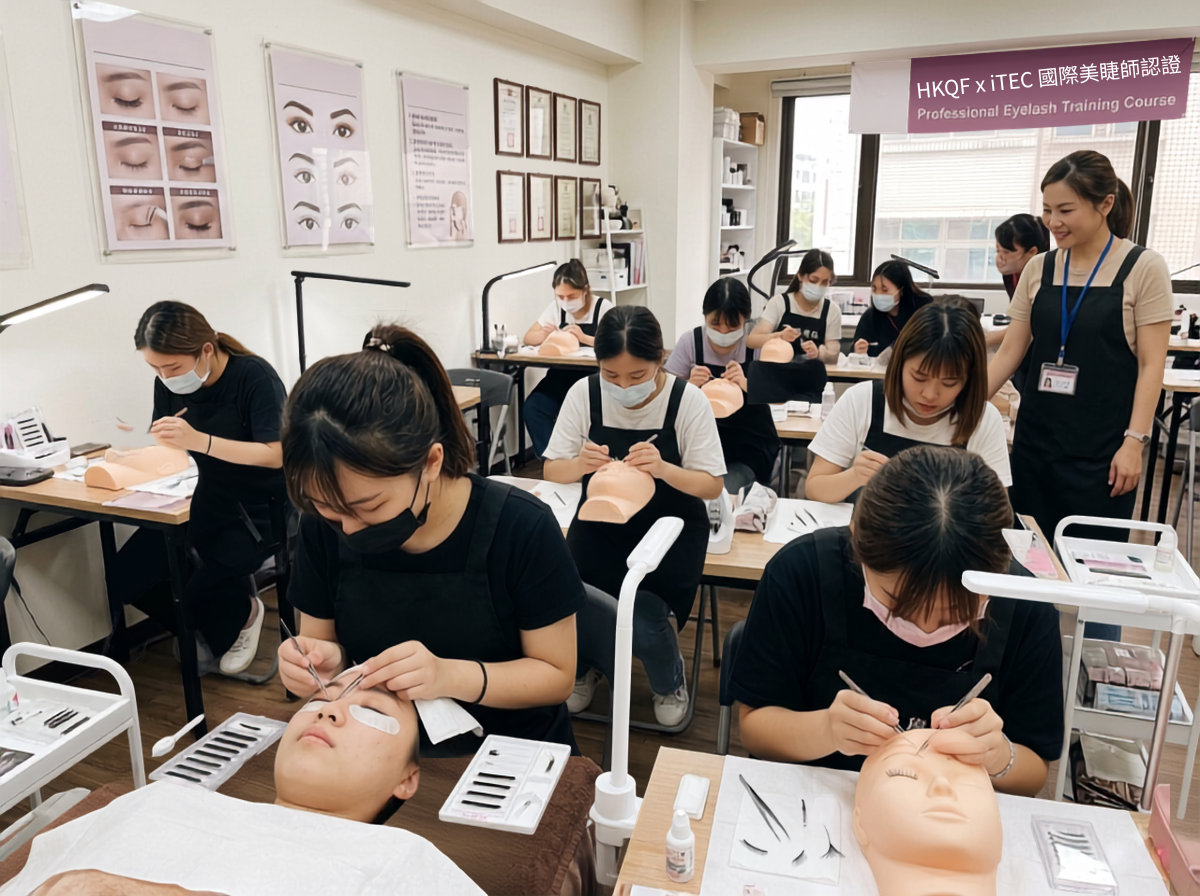
5. Why Choose LBEDU? Government‑Recognised Qualifications & CEF Subsidies
As a government‑registered institution (School Registration No. 854), LBEDU is dedicated to professionalising and regulating Hong Kong's beauty industry:
- CEF Subsidies: Eligible students can receive up to 80‑85% tuition reimbursement for designated eyelash courses, significantly lowering the barrier to professional training.
- Direct Pathway to iTEC International Qualification: Course content directly prepares students for the iTEC Level 3 international eyelash diploma – graduates earn both local and internationally recognised credentials.
- Authentic Teaching Materials: All glues and tools used in class are strictly vetted for safety, ensuring a safe, non‑toxic learning environment.
- Career Development & Compliance Guidance: Beyond technical skills, we provide client consent form templates and salon hygiene compliance guides to help you launch your career or business.
Industry Observation: The More Chaotic the Market, the More Professionalism Shines
When news reports expose the safety risks of low‑quality black glue, untrained practitioners panic – but internationally certified lash artists turn this into an opportunity to build client trust.
When clients ask: "Is your glue safe? Does it contain formaldehyde?"
With iTEC professional training, you can confidently present product safety reports, explain the curing chemistry of cyanoacrylate, proactively offer patch tests, and demonstrate internationally compliant hygiene procedures. This is the value gap between an "internationally certified lash artist" and an "average worker"!
Frequently Asked Questions
Conclusion: Invest in Professional Qualifications – Build a Sustainable Beauty Career
The eyelash glue testing news is another wake‑up call for the beauty industry: business models built on "low prices" and "cheap, substandard materials" are not sustainable. Only by adhering to safety, professionalism, and quality can you earn the respect of the market.
Obtaining iTEC international eyelash certification is not just about learning a beautiful application technique – it's about building a solid safety barrier between you and your clients. Let LBEDU guide you through your first steps toward professional practice, helping you become a respected and trusted authority in the industry!
References & Regulatory Frameworks
VTCT (ITEC) Level 3 Award in Eyelash Treatments – Official Assessment & Hygiene Standards Syllabus
Hong Kong Qualifications Framework (HKQF) – Eyelash Techniques & Infection Control (Level 3) Competency Standards
EU Cosmetics Regulation (EC) No 1223/2009 – Safety Standards for Eyelash Adhesive Ingredients
Consumer Council / Shanghai Consumer Protection Commission – Eyelash Glue Safety Testing Analysis Reports
LBEDU Luster Beauty International Education and Training IAcademy – CEF‑Approved Eyelash Course Syllabus
ISO 22716:2007 – Cosmetics Good Manufacturing Practices (GMP) International Standard
SGS Consumer Product Testing Standards & Eyelash Product Safety Testing Guidelines
Comments (0)
No comments yet
Leave a Comment